
Cavapoo Training Guide, Cavapoo Care Guide
Types of Service Dogs: Roles, Breeds, Training, and What You Need to Know
Aug
Service dogs perform an incredible role in the lives of people with disabilities. Through specialized training, these dogs can perform tasks that help their handlers navigate everyday life with greater safety, independence, and confidence.
A service dog is more than a well-behaved pet. Under the Americans with Disabilities Act (ADA), a service animal is a dog that has been individually trained to perform work or tasks directly related to a person’s disability. The ADA does not limit service animals to a particular breed or size.
Service dogs can assist people with physical, sensory, psychiatric, and other disabilities. Their responsibilities can range from guiding a person who is blind to retrieving objects, providing mobility assistance, alerting a handler to certain medical conditions, or performing trained tasks during a psychiatric episode.
In this guide, we’ll explain the different types of service dogs, the breeds commonly selected for service work, how service-dog training works, and an important point that is often misunderstood: service dogs do not need to be registered or certified under federal ADA law.
What Is a Service Dog?
A service dog is a dog individually trained to perform specific tasks for a person with a disability.
The task must be directly related to the person’s disability.
For example, a dog trained to retrieve medication for someone with a disability may qualify as a service dog. A dog trained to recognize an approaching medical event and alert its handler may also qualify.
Simply providing companionship or emotional comfort does not, by itself, make a dog a service animal under the ADA. A psychiatric service dog can qualify when it is trained to perform a specific task related to a person’s disability.
This distinction is important because service dogs, emotional support animals, therapy dogs, and ordinary pets are not legally identical categories.
What Types of Service Dogs Are There?
Service dogs can be trained for many different jobs.
Some of the most common categories include:
- Guide dogs.
- Hearing dogs.
- Mobility assistance dogs.
- Autism service dogs.
- Psychiatric service dogs.
- PTSD service dogs.
- Medical alert dogs.
- Diabetic alert dogs.
- Seizure response dogs.
- Allergy detection dogs.
- Medical response dogs.
- Retrieval and assistance dogs.
The exact tasks performed by a service dog depend on the individual handler’s disability and needs.
Guide Dogs
Guide dogs help people who are blind or have significant vision impairment navigate their surroundings.
A guide dog may help its handler move around obstacles, navigate routes, and safely travel through everyday environments.
Labrador Retrievers, Golden Retrievers, and German Shepherd Dogs are among the breeds commonly associated with guide-dog work.
Hearing Service Dogs
Hearing dogs assist people who are deaf or hard of hearing.
They can be trained to alert their handlers to important sounds such as:
- Doorbells.
- Alarm clocks.
- Smoke alarms.
- Knocking.
- Telephone calls.
- A person’s name being called.
- Other important environmental sounds.
The dog may alert the handler and then lead them toward the source of the sound.
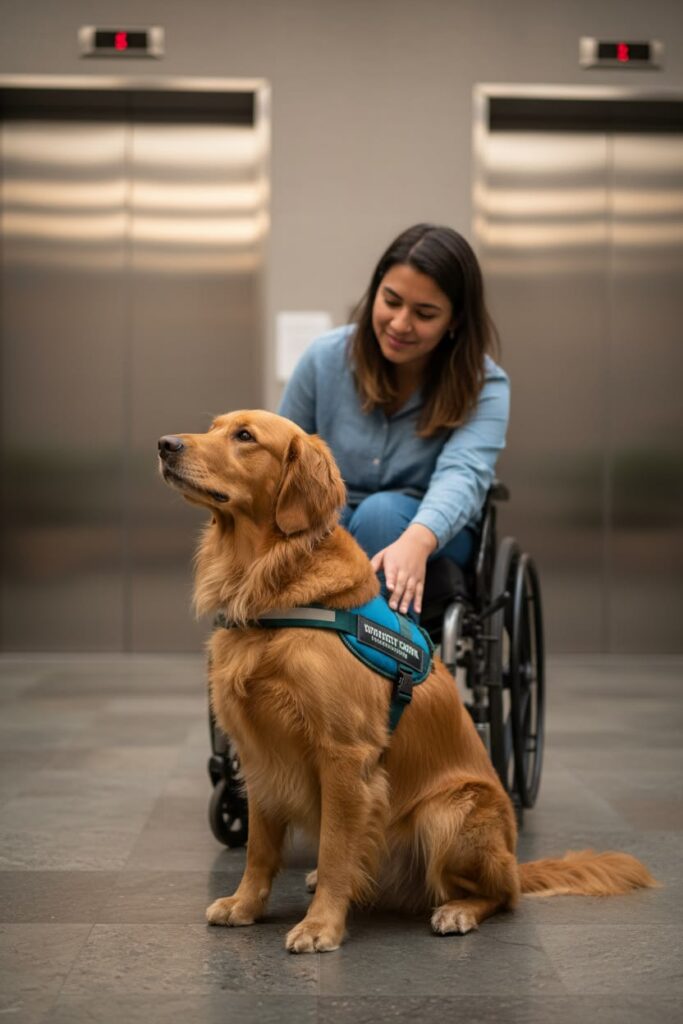
Mobility Assistance Dogs
Mobility assistance dogs help people with physical disabilities perform specific tasks.
Depending on the handler’s needs, a dog may retrieve objects, open doors, operate accessible switches, or provide certain forms of physical assistance.
Larger dogs may be particularly appropriate for tasks requiring substantial physical strength. However, the appropriate breed and size always depend on the specific job the dog needs to perform.
Autism Service Dogs
Autism service dogs can be trained to perform specific tasks for people with autism.
Depending on the individual, tasks may include helping interrupt certain behaviors, assisting with safety, retrieving items, or helping a handler navigate particular situations.
The dog must be trained to perform a disability-related task to qualify as a service animal under the ADA.
Simply having a calming presence does not automatically make a dog a service animal.
Psychiatric Service Dogs
Psychiatric service dogs assist people with psychiatric disabilities by performing trained tasks.
A psychiatric service dog may be trained to interrupt a harmful behavior, remind a handler to perform a necessary action, retrieve medication, or perform another specific disability-related task.
This is different from an emotional support dog whose primary role is providing comfort through its presence.
The ADA specifically distinguishes between emotional support and trained disability-related tasks.
PTSD Service Dogs
PTSD service dogs may be trained to perform tasks for people living with post-traumatic stress disorder.
Depending on the person’s needs, tasks can include interrupting distress-related behaviors, creating physical space, retrieving medication, waking a person from nightmares, or performing another specifically trained response.
A dog does not qualify simply because its presence makes someone feel calmer. The dog must perform a trained task directly related to the disability.
Medical Alert Dogs
Medical alert dogs can be trained to detect or respond to certain changes associated with a medical condition.
Depending on their training, they may alert a person to a medical event or perform another trained response.
Diabetes alert dogs and seizure response dogs are examples of specialized medical service work.
Diabetic Alert Dogs
Some dogs are trained to alert their handlers to changes associated with blood glucose levels.
The exact abilities and reliability of individual dogs can vary, so medical alert dogs should be considered part of a broader medical support plan rather than a replacement for medical devices or professional care.
Seizure Response Dogs
Seizure response dogs are trained to perform specific actions during or after a seizure.
Depending on the individual handler, a trained response might include activating an alert system, retrieving assistance, creating a safe environment, or performing another predetermined task.
It is important to distinguish seizure response from claims that every dog can reliably predict seizures before they occur.
Allergy Detection Dogs
Some dogs are trained to detect specific allergens.
For people with severe allergies, a trained dog may be taught to locate or alert to an allergen in particular circumstances.
Poodles are among the breeds that have been used for scent-based service work because of their intelligence, trainability, and scenting abilities.
What Makes a Good Service Dog?
Breed is only one part of the equation.
A successful service dog needs the right temperament, physical ability, training, and willingness to work.
According to the American Kennel Club, effective service dogs generally need to be reliable, calm, attentive, trainable, and able to remain focused around people, animals, traffic, and other distractions.
Important qualities include:
- Strong trainability.
- Reliable temperament.
- Good impulse control.
- Ability to remain focused.
- Appropriate energy level.
- Confidence without unnecessary reactivity.
- Comfort around people.
- Ability to work around distractions.
- Physical suitability for the required tasks.
- Strong handler-dog communication.
A beautiful dog is not necessarily a good service dog.
A highly intelligent dog is not automatically a good service dog either.
The individual dog’s temperament and ability to perform the required tasks are extremely important.
Common Service Dog Breeds
Service dogs can be any breed or size under the ADA.
However, some breeds are commonly selected because their characteristics make them suitable for particular types of work.
Labrador Retriever
Labrador Retrievers are among the best-known service dog breeds.
They are intelligent, social, athletic, and generally eager to work with people.
Their combination of trainability and approachable temperament has made them popular in service-dog programs.
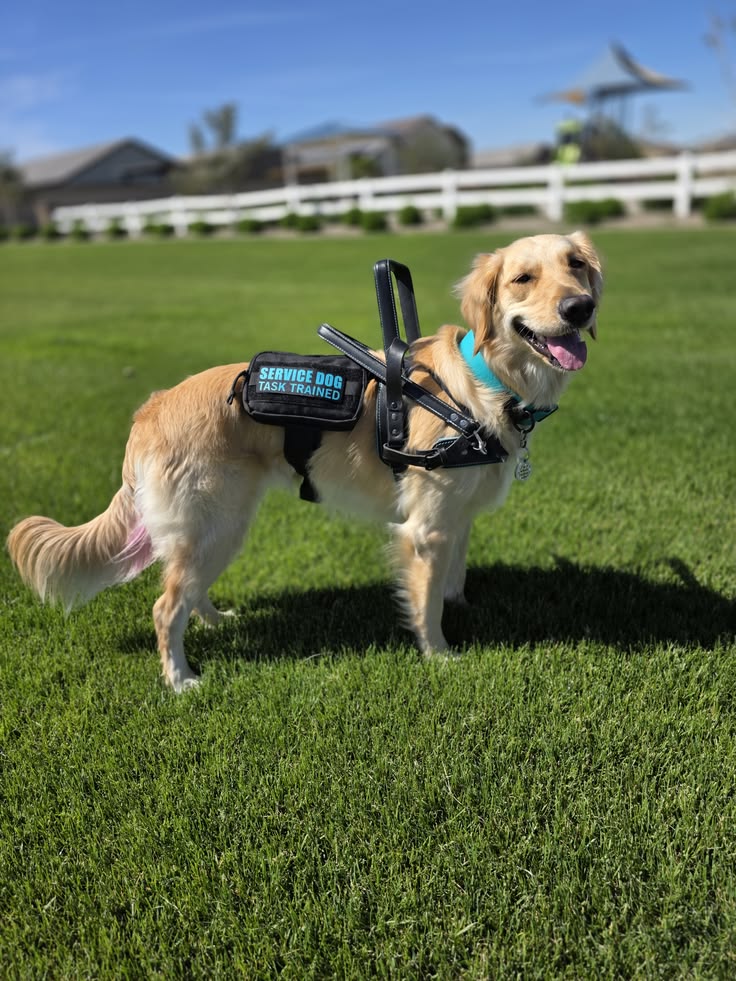
Golden Retriever
Golden Retrievers are another popular choice.
Their sociable temperament, intelligence, trainability, and willingness to work with people can make them excellent candidates for many forms of assistance work.
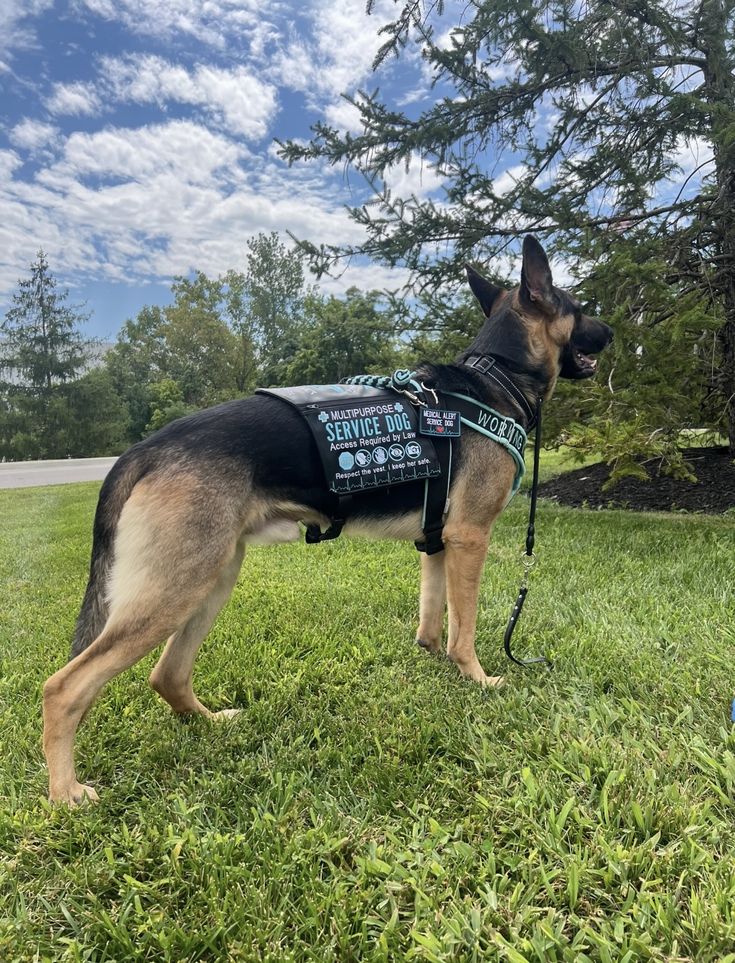
German Shepherd Dog
German Shepherd Dogs have a long history of working alongside people.
Their intelligence, loyalty, confidence, and ability to learn complex tasks can make them suitable for various forms of service work, including guide work.
Poodle
Poodles are highly intelligent and versatile dogs.
Standard Poodles can be large enough for certain physically demanding tasks, while smaller Poodles may be suitable for tasks that do not require substantial physical strength.
Their trainability and lower-shedding coat can also be valuable characteristics for some handlers.
Bernese Mountain Dog
Bernese Mountain Dogs are large, intelligent, loyal dogs with a generally calm nature.
Their size and strength can make them appropriate for certain assistance roles, particularly when a larger dog is required.
Great Dane
Great Danes have the size and strength necessary for some types of physical assistance.
However, their suitability depends on the individual dog’s temperament and the specific tasks required.
Saint Bernard
Saint Bernards have a long history of working alongside humans.
Their strength and size can make them candidates for certain assistance roles, although their size also means that handlers must consider housing, transportation, grooming, and other practical requirements.
Pomeranian
A small dog can also be a legitimate service dog.
Pomeranians have been used for tasks such as hearing assistance and certain alerting roles. Their small size can make them easier to transport and accommodate in some environments.
Border Collie
Border Collies are exceptionally intelligent and responsive dogs.
Their ability to learn complex behaviors can be valuable for certain working roles, although high energy levels and sensitivity mean that individual temperament must be carefully considered.
Can a Cavapoo Be a Service Dog?
Cavapoos are intelligent, social, affectionate dogs that can be highly responsive to training.
However, not every Cavapoo is suitable for service work.
Service-dog suitability depends on the individual dog’s temperament, health, confidence, trainability, size, focus, and ability to perform specific tasks reliably in distracting environments.
A Cavapoo may potentially be appropriate for certain disability-related tasks that do not require substantial physical strength, but suitability should be evaluated on an individual basis.
If you’re interested in Cavapoos, you can learn more about the breed through our Cavapoo Breed Guide.
For families considering bringing home a Cavapoo puppy, our Available Cavapoo Puppies page provides information about the puppies currently available.
Are Service Dogs Required to Be Professionally Trained?
No.
This is another common misconception.
The ADA does not require a service dog to be trained by a professional service-dog organization.
Under federal ADA rules, a person with a disability may train their own service dog. The important requirement is that the dog is individually trained to perform work or tasks directly related to the person’s disability.
However, professional assistance can be extremely valuable.
Service-dog training can be complex, and handlers may choose to work with experienced trainers or service-dog organizations to develop reliable public-access behavior and disability-related tasks.
State and local laws can also differ, particularly regarding service dogs in training.
Do Service Dogs Need to Wear a Vest?
No.
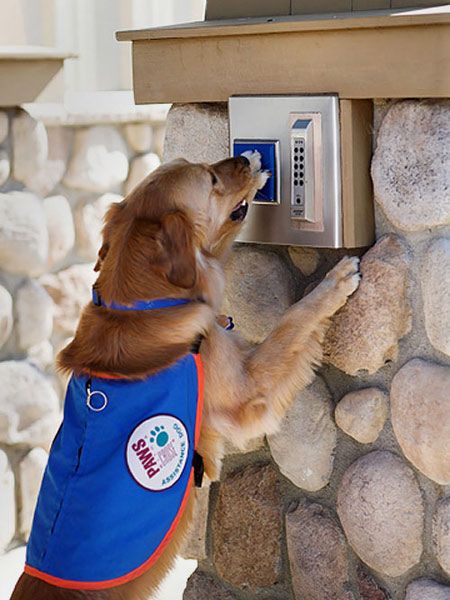
The ADA does not require a service dog to wear a vest, special harness, identification tag, or other equipment identifying it as a service animal.
Some handlers choose to use identification equipment because it can reduce confusion in public.
However, wearing a vest does not automatically make a dog a service animal.
The dog’s training and disability-related work are what matter under the ADA.
Do Service Dogs Need to Be Registered or Certified?
No.
This is one of the most important corrections to make to older online information about service dogs.
The ADA does not require service dogs to be certified or registered.
Businesses and other covered entities generally cannot require documentation proving that a dog has been certified, trained, or registered as a service animal. The U.S. Department of Justice specifically states that online service-animal certification and registration documents do not provide ADA rights.
When it is not obvious that a dog is a service animal, a covered business may generally ask only two questions:
- Is the dog a service animal required because of a disability?
- What work or task has the dog been trained to perform?
They generally cannot ask about the person’s disability, demand documentation, or require the dog to demonstrate its task.
What About Local Dog Registration?
There is an important distinction.
A city or state may require dogs to comply with ordinary licensing, vaccination, or animal-control rules that apply to dogs generally.
That is different from requiring a special federal-style “service dog registration.”
The ADA states that mandatory service-animal registration is not permissible under the ADA, although ordinary local dog licensing requirements can still apply.
Service Dogs vs. Emotional Support Dogs
The terms are often confused.
A service dog is trained to perform work or tasks directly related to a person’s disability.
An emotional support animal can provide comfort or emotional support but does not qualify as an ADA service animal merely because its presence provides comfort.
For example, if a dog has been trained to recognize an anxiety episode and perform a specific action to help its handler, that may qualify as a psychiatric service task.
If the dog simply makes its owner feel better by being present, that alone does not meet the ADA service-animal definition.
Service Dogs vs. Therapy Dogs
Therapy dogs are also different from service dogs.
Therapy dogs generally visit places such as hospitals, schools, nursing homes, or other facilities to provide comfort and companionship to multiple people.
A service dog is trained to assist its individual handler with disability-related tasks.
The distinction is important because the legal protections and access rights are different.
Service Dogs Need Proper Care Too
A service dog may have an important job, but it is still a dog with normal physical and emotional needs.
Handlers remain responsible for feeding, grooming, veterinary care, toileting, and general supervision.
A service dog needs:
- Appropriate nutrition.
- Regular veterinary care.
- Dental care.
- Exercise appropriate to its breed and job.
- Mental stimulation.
- Grooming.
- Adequate rest.
- Positive training.
- A safe environment.
- Time away from work when appropriate.
If you are raising a puppy, our Cavapoo Care Guide covers many of the fundamentals involved in caring for a young dog.
You can also learn more about How to Train a Cavapoo Puppy if you are interested in building reliable obedience skills from an early age.
Final Thoughts
Service dogs provide extraordinary assistance to people with disabilities.
They can guide people with vision loss, alert people to sounds or medical conditions, assist with mobility, retrieve objects, respond to psychiatric disabilities, and perform many other highly specialized tasks.
While Labrador Retrievers, Golden Retrievers, German Shepherd Dogs, and Poodles are among the most commonly recognized service-dog breeds, there is no single breed that is right for every job. The ADA allows service dogs of any breed and size, provided they are individually trained to perform work or tasks directly related to a person’s disability.
It is also important to remember that service dogs do not need federal certification or registration.
If you’re researching service dogs for yourself or someone in your family, focus on the dog’s temperament, health, training ability, task requirements, and the specific needs of the person who will handle the dog.
For official legal information, always rely on the U.S. Department of Justice ADA service-animal guidance rather than websites selling service-dog registration or certification documents.
Continue Learning About Dogs and Cavapoos
If you’re interested in learning more about choosing and raising the right dog, explore our Cavapoo Breed Guide, Cavapoo Care Guide, and How to Train a Cavapoo Puppy.
You can also learn about our Health Guarantee, understand the Adoption Process, review our Shipping & Delivery information, or browse our Available Cavapoo Puppies.
For authoritative information about service animals, visit the ADA’s official service-animal guidance and the ADA’s Frequently Asked Questions about Service Animals.
