
Cavapoo Care Guide, Cavapoo Temperament Guide, Grooming Guide
Why Puppy Socialization Matters: A Complete Cavapoo Socialization Guide
Sep
Bringing a Cavapoo puppy home is an exciting experience. Everything is new: the people in the household, the sounds of appliances, the feel of different surfaces, car rides, visitors, grooming, outdoor environments, and eventually the many people, dogs, and situations your puppy will encounter throughout life.
Helping your puppy learn that new experiences can be safe and positive is one of the most important parts of raising a well-adjusted dog.
This process is called puppy socialization.
Socialization is sometimes misunderstood as simply allowing a puppy to play with lots of other dogs. In reality, good socialization is much broader. It means carefully introducing your puppy to different people, environments, sounds, surfaces, handling experiences, animals, routines, and everyday situations while keeping those experiences positive and appropriate for the individual puppy.
The goal isn’t to make your Cavapoo interact with everyone.
The goal is to help your puppy learn how to remain comfortable, curious, and connected to you when encountering something unfamiliar.
This is the foundation of Cavapoo puppy socialization and is an important part of developing appropriate Cavapoo puppy behavior.
Why Is Puppy Socialization Important?
Puppies are learning about the world from the moment they are born.
Their early experiences can influence how they respond to unfamiliar situations later in life. The American Veterinary Society of Animal Behavior identifies the first three months as the primary and most important period for puppy socialization and recommends safe exposure to new people, animals, stimuli, and environments during this time.
This period is often called the puppy socialization period or puppy socialization window.
That does not mean socialization ends at three months.
Dogs continue learning throughout their lives, and positive experiences remain valuable beyond puppyhood.
However, the early months provide an especially important opportunity to help a puppy develop confidence and appropriate responses to everyday experiences. AKC guidance also emphasizes that positive experiences during this early developmental period can influence how puppies respond to their environment later in life.
For a Cavapoo, that might mean learning that:
A vacuum cleaner isn’t something to fear.
A car ride can be normal.
A veterinarian can be a safe person.
A grooming table is not automatically frightening.
Different floor surfaces are okay.
Children can be calm and predictable.
A stranger walking past does not require an interaction.
Another dog does not always mean playtime.
A new environment can be explored gradually.
These lessons can become valuable foundations for adult life.
Understanding why socialize your puppy becomes easier when you consider how many everyday situations your Cavapoo will eventually experience.
Good socialization can support puppy confidence, appropriate puppy behavior, and the ability to recover calmly from unfamiliar experiences.
What Does Socialization Actually Mean?
Puppy socialization is not the same as making your puppy say hello to everyone.
It is also not the same as taking your puppy to a crowded dog park and allowing dozens of unfamiliar dogs to approach.
Effective socialization is about positive, controlled exposure.
Your Cavapoo should be allowed to observe new things without being forced to interact with them.
For example, you could sit with your puppy somewhere safe and allow them to watch people walking by.
You might introduce your puppy to a new household sound at a low intensity.
You could allow your puppy to walk across a new surface while rewarding calm behavior.
You might introduce a friendly, healthy, appropriately vaccinated dog in a controlled environment.
You could practice gentle handling of your puppy’s ears, paws, mouth, coat, and tail while pairing the experience with rewards.
These experiences teach your puppy that unfamiliar does not automatically mean dangerous.
This is what puppy exposure training should look like: gradual, controlled, and appropriate for the individual puppy.
The goal is not simply exposure.
The goal is creating positive associations while helping your puppy remain comfortable.
When Should Puppy Socialization Start?
The most important socialization period occurs very early in life.
AVSAB identifies the first three months as the primary socialization period. Current AKC guidance similarly emphasizes the first three months and notes that responsible breeders can begin appropriate socialization before puppies go to their new homes.
This is one reason the breeder’s role matters.
Before you bring a Cavapoo puppy home, ask how the puppies have been exposed to people, handling, household sounds, different environments, grooming preparation, crates, and transportation.
AAHA also recommends asking breeders or rescue organizations about a puppy’s early socialization and background before bringing the puppy home.
Once your Cavapoo comes home, socialization becomes a shared responsibility.
Your job is to continue building on those early experiences without overwhelming the puppy.
The puppy socialization window is important, but it should not create unnecessary pressure to expose your puppy to everything at once.
Responsible socializing a Cavapoo puppy means choosing appropriate experiences and allowing the puppy time to process them.
Socialization Does Not End After 12 Weeks
One of the biggest misconceptions about puppy socialization is that owners have to accomplish everything before a certain birthday.
That can create unnecessary pressure.
Dogs continue learning from experience throughout their lives. AAHA notes that dogs do not simply stop learning after sensitive developmental stages, and individual development varies.
A puppy that is already several months old can still learn.
An adolescent dog can still become more comfortable with new experiences.
An adult dog can learn new skills and associations.
The approach may simply need to be slower and more individualized.
So if your Cavapoo missed some early experiences, don’t assume that all opportunities have disappeared.
Start where your dog is comfortable and build gradually.
This is also important during puppy fear periods. A puppy that suddenly becomes cautious about something familiar may simply need more distance, patience, and positive experiences. AKC notes that puppies can experience fear periods during early development, including around the broader socialization stage.
Socialization and Vaccinations: Finding the Right Balance
This is one of the most important parts of puppy socialization.
Young puppies are vulnerable to infectious diseases, including diseases that can spread through contact with infected animals or contaminated environments.
At the same time, keeping a puppy completely isolated until every vaccination is finished can mean missing important opportunities for controlled social development.
Current veterinary behavior guidance therefore focuses on safe socialization rather than complete isolation.
AAHA states that there is no medical reason to automatically delay puppy classes or social exposure until the vaccination series is complete when appropriate precautions are taken, sick animals are avoided, and good hygiene is practiced.
Your veterinarian should help you determine what is appropriate for your puppy based on vaccination status, local disease risks, health history, and the environments you plan to visit.
A puppy might safely observe the outside world from your arms, for example, without being placed on a contaminated public surface.
Your veterinarian may also approve carefully selected interactions with healthy, vaccinated dogs you know.
The key is to avoid treating all environments as equally safe.
This approach to puppy socialization before vaccinations helps balance behavioral development with infectious-disease precautions.
Safe Socialization Before Full Vaccination
Your puppy does not need to sit inside the house and experience nothing until vaccinations are complete.
There are many low-risk ways to introduce new experiences.
You can carry your puppy outside and let them watch the world.
You can take short car rides.
You can sit with your puppy on a clean blanket in an appropriate outdoor location.
You can invite calm visitors into your home.
You can introduce different household sounds gradually.
You can practice gentle grooming and handling.
You can expose your puppy to different surfaces in a clean, controlled environment.
You can allow carefully selected interaction with healthy, vaccinated dogs when your veterinarian considers it appropriate.
AAHA’s current puppy guidance specifically recommends controlled exposure, observation from safe positions, gradual introduction to novelty, and paying attention to body language.
These are practical puppy socialization tips that can help you provide safe puppy socialization without unnecessarily overwhelming your puppy.
Avoid the “Meet Everyone” Approach
More socialization is not necessarily better.
The quality of the experience matters.
Imagine taking your small Cavapoo puppy into a crowded environment where several strangers immediately bend over, reach toward the puppy, pick them up, and try to pet them.
From the human perspective, everyone is being friendly.
From the puppy’s perspective, however, the experience may be overwhelming.
A better approach is to give your puppy choices.
Let the puppy observe.
Allow the puppy to approach when comfortable.
Reward calm behavior.
Give the puppy somewhere to retreat.
If your puppy shows fear, increase distance and reduce the intensity of the experience.
Socialization should build confidence rather than force interaction.
Current AKC guidance similarly recommends taking baby steps and avoiding too much stimulation too quickly.
Learn to Read Your Cavapoo’s Body Language
One of the most valuable skills a puppy owner can develop is learning to recognize signs of comfort and stress.
A relaxed puppy may have a loose body, natural movement, and an ability to take treats or engage with you.
A worried puppy may back away, freeze, hide, tuck the tail, avoid eye contact, lick their lips, yawn repeatedly, or otherwise show signs that the situation is becoming too intense.
The exact meaning of a behavior depends on the entire context.
AAHA recommends paying attention to body language and warns that forced exposure can worsen fear in some puppies.
If your Cavapoo is telling you that something is too much, listen.
Creating distance is not failure.
It is good handling.
Understanding body language is one of the most valuable puppy training tips you can learn.
Socializing Your Cavapoo With People
People come in many different forms.
Your puppy may eventually encounter:
Adults.
Children.
Older people.
People wearing hats.
People wearing uniforms.
People carrying bags.
People using walking sticks.
People with umbrellas.
People wearing bulky coats.
People moving quickly.
People moving slowly.
People with different voices and appearances.
You don’t need to introduce all of these experiences in one day.
Instead, gradually expose your Cavapoo to different people in controlled situations.
Ask visitors not to rush toward your puppy.
Allow the puppy to approach voluntarily.
Reward calm observation.
If your puppy chooses to move away, allow that space.
The goal is not to make your puppy love every stranger.
The goal is to help your puppy understand that unfamiliar people can be safely present.
This is the foundation of puppy socialization with people.
It is also an important part of teaching a Cavapoo appropriate social behavior rather than simply encouraging constant greetings.
Socializing Your Cavapoo Around Children
Children can be wonderful companions for Cavapoos, but children and puppies don’t always communicate naturally.
A puppy may find running, squealing, sudden movements, grabbing, or hugging overwhelming.
Children also need to learn appropriate ways to interact with dogs.
Teach children not to:
- chase the puppy
- corner the puppy
- pull ears or tails
- take food away
- climb on the puppy
- disturb the puppy while sleeping
- force hugs
- approach when the puppy is trying to retreat
Instead, encourage calm interaction under adult supervision.
Socialization works in both directions: the puppy learns about children, and children learn how to behave around the puppy.
This is an important part of puppy socialization around children.
The goal is a predictable and respectful relationship between the child and puppy.
Socializing Your Cavapoo With Other Dogs
Meeting other dogs can be part of socialization, but dog-to-dog interaction should be carefully selected.
Your puppy does not need to greet every dog they see.
A calm, healthy, appropriately vaccinated adult dog belonging to someone you trust may provide a much better introduction than an uncontrolled encounter with an unfamiliar dog.
The temperament of the other dog matters.
A large, rough, overly enthusiastic dog may frighten a small Cavapoo puppy even if that dog is friendly.
Good socialization means choosing interactions that are appropriate for the puppy.
AKC guidance also recommends caution around unknown dogs and potentially contaminated public environments before a puppy has completed the vaccination process.
This makes puppy socialization with dogs very different from simply allowing unlimited dog-to-dog contact.
Controlled dog socialization should prioritize safety, appropriate play, and your puppy’s comfort.
Puppy Classes Can Help
A well-run puppy class can provide an opportunity for controlled exposure to people, dogs, handling, sounds, and training.
However, not every puppy class is the same.
Ask about:
- vaccination requirements
- cleaning procedures
- class size
- trainer qualifications
- how interactions are supervised
- whether puppies are allowed to become overwhelmed
- training methods
- how fearful puppies are handled
A good class should not simply release puppies into a room and allow uncontrolled chaos.
The goal should be safe learning.
AAHA recommends appropriate puppy classes and structured positive exposure during sensitive developmental periods.
AVSAB also supports appropriate puppy classes as a structured opportunity for early socialization and positive training.
Puppy classes can therefore combine puppy socialization training, basic Cavapoo puppy training, and positive exposure.
Socialization at Home
You don’t need to leave the house to socialize your puppy.
Your home contains dozens of opportunities.
This makes puppy socialization at home an important part of your routine.
Introduce your Cavapoo gradually to:
The vacuum cleaner.
The washing machine.
Doorbells.
Kitchen sounds.
Hair dryers.
Television noises.
Different flooring.
Stairs, when appropriate and safe.
Crates.
Carriers.
Collars and harnesses.
Brushing.
Nail handling.
Ear checks.
Tooth brushing preparation.
Being gently touched around the body.
The important word is gradually.
Don’t turn every new experience into a major event.
Let your puppy observe, investigate, and recover.
This everyday approach can make how to socialize a puppy much easier for new owners.
Socialization and Grooming
Cavapoos require regular coat care, so grooming socialization deserves special attention.
Your puppy should gradually learn that brushing, touching the paws, looking at the ears, handling the face, and being around grooming equipment are normal parts of life.
Start with very short sessions.
Touch a paw.
Reward.
Touch an ear.
Reward.
Brush one small area.
Reward.
Stop while your puppy is still comfortable.
Over time, these tiny sessions can become a foundation for future grooming appointments.
This can make professional grooming less stressful for both the dog and the groomer.
It also supports positive Cavapoo puppy behavior around handling and grooming.
Socialization and Veterinary Visits
Your puppy will need veterinary care throughout life.
That makes veterinary socialization especially valuable.
You can help your puppy develop positive associations with:
Being touched.
Having paws examined.
Having ears checked.
Standing on a scale.
Being gently restrained.
Hearing unfamiliar sounds.
Being around veterinary staff.
If your veterinary clinic allows it, ask whether short positive visits are possible when your puppy doesn’t require medical treatment.
AAHA recommends discussing behavior and socialization with the veterinary team during puppy wellness visits.
These experiences can become useful parts of puppy exposure training.
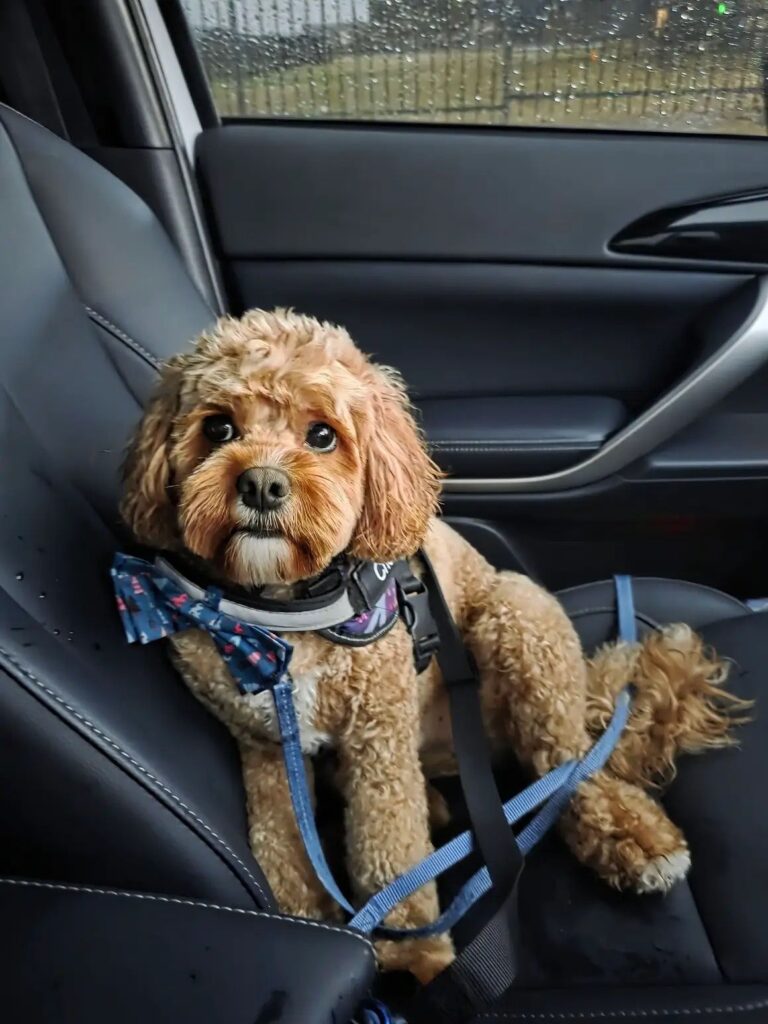
Socializing Your Cavapoo to Car Rides
Car rides are another everyday experience worth introducing gradually.
Begin with the puppy safely secured.
Start with short trips.
You might initially sit in the parked vehicle without driving.
Then take a very short ride.
Gradually increase the duration.
Pair calm behavior with rewards.
Never allow a puppy to ride unsecured in the vehicle.
The goal is for your Cavapoo to learn that getting into a vehicle is a normal part of life.
This becomes especially useful for veterinary visits, grooming appointments, family outings, vacations, and other travel.
Socialization and Different Sounds
Dogs experience the world through their senses, and unfamiliar sounds can be particularly startling.
You might gradually introduce your Cavapoo to:
Thunder recordings at low volume.
Traffic.
Vacuum cleaners.
Doorbells.
Hair dryers.
Kitchen appliances.
Children playing.
Television.
Outdoor noises.
Construction sounds.
The volume and intensity should remain low enough that your puppy can stay relaxed.
If your puppy becomes frightened, reduce the intensity rather than forcing them to remain near the sound.
This gradual approach can help build puppy confidence around everyday noises.
Socializing Your Cavapoo to Different Environments
Your puppy may eventually visit many different environments.
Think about introducing experiences such as:
A quiet neighborhood.
A friend’s house.
A calm outdoor area.
A veterinary clinic.
A grooming salon.
A pet-friendly business when appropriate.
Different types of flooring.
Elevators.
Stairs.
Parking areas.
Quiet parks when your veterinarian says the environment is appropriate.
You do not need to visit all these places immediately.
Choose one new experience at a time.
This is one of the most practical puppy socialization tips for avoiding sensory overload.
Don’t Force a Fearful Puppy
This is one of the most important lessons in the entire article.
If your puppy is frightened, forcing them closer to the scary object or person can make the fear worse.
AAHA specifically warns that forced social exposure can aggravate fear and that fearful puppies may require a different approach.
Instead, create distance.
Let your puppy observe.
Reward calm behavior.
Try again another day at a lower intensity.
If your puppy consistently shows significant fear, speak with your veterinarian or a qualified veterinary behavior professional.
Early help can be much easier than waiting until the behavior becomes deeply established.
Remember that puppy fear periods can occur during development. A temporary increase in caution does not automatically mean your socialization efforts have failed.
Socialization Is Not the Same as Obedience
A puppy can know how to sit and still be uncomfortable around strangers.
A puppy can know how to stay and still panic during a car ride.
A puppy can know how to come when called and still fear a grooming appointment.
Training and socialization overlap, but they are not identical.
Obedience teaches behaviors.
Socialization helps your puppy develop appropriate responses to experiences and environments.
Both are valuable.
This is why Cavapoo puppy training should work alongside socialization rather than replace it.
Positive Reinforcement Makes Socialization Easier
Rewards can help your Cavapoo form positive associations with new experiences.
If your puppy sees a person at a comfortable distance and remains relaxed, you can reward that behavior.
If your puppy calmly investigates a new surface, reward them.
If your puppy allows gentle paw handling, reward them.
If your puppy calmly enters the car, reward them.
The reward doesn’t have to be food every time.
Praise, play, access to something enjoyable, and other appropriate rewards can also be useful.
AVSAB’s current public guidance recommends reward-based training methods for dogs.
This approach supports positive puppy training and can make puppy socialization training more enjoyable for both the puppy and owner.
Positive experiences are especially useful when developing new behaviors or helping a puppy become comfortable with unfamiliar situations.
A Simple Cavapoo Puppy Socialization Routine
Instead of trying to expose your puppy to everything at once, build socialization into normal life.
One day might involve calmly meeting a new person.
Another might involve hearing a household appliance.
Another could involve a short car ride.
Another might involve walking across a new surface.
Another could involve gentle grooming practice.
Another might involve calmly watching people from a safe distance.
This approach makes socialization part of everyday life rather than a stressful project.
For many owners, these simple puppy training tips are easier to maintain than creating complicated daily training sessions.
A Cavapoo Puppy Socialization Checklist
As your puppy develops, consider gradually introducing:
People: adults, children, visitors, people wearing different clothing.
Sounds: household appliances, traffic, doors, outdoor noises.
Surfaces: carpet, tile, grass, mats, wood, and other safe surfaces.
Handling: paws, ears, mouth, coat, collar, harness, grooming tools.
Transportation: car rides and safe travel equipment.
Environments: home, quiet outdoor areas, veterinary settings, appropriate public spaces.
Animals: carefully selected healthy and vaccinated dogs when appropriate.
Routine experiences: grooming, veterinary handling, resting in a crate or carrier, and being calmly separated for short periods.
The objective is not to complete a checklist as quickly as possible.
The objective is to help your puppy have good experiences.
This puppy socialization checklist should be treated as a guide rather than a race.
Every puppy is different.
How Socialization Helps Families
A well-socialized dog can often participate more comfortably in everyday family life.
That may include walks, visitors, grooming appointments, car rides, outdoor activities, veterinary care, and family travel.
For a Cavapoo, whose owners may want a close family companion, these everyday experiences are particularly important.
The better your puppy understands the world, the easier it may be for you to build a routine around that dog.
But remember that socialization does not guarantee a particular adult temperament.
Genetics, early experiences, health, environment, learning, and individual personality all matter.
This is particularly important when discussing Cavapoo temperament. Socialization can influence how a puppy learns to respond to experiences, but it does not completely determine personality.
Choosing a Well-Socialized Cavapoo Puppy
If you are researching Cavapoo Puppies For-Sale Near Me, don’t only ask about the puppy’s appearance, color, or size.
Ask how the puppies are being socialized before they go home.
Useful questions include:
How are puppies handled?
Do puppies experience different household sounds?
Are they exposed to different surfaces?
Do they experience safe car rides?
How are grooming behaviors introduced?
How does the breeder respond when a puppy appears fearful?
What experiences have the puppies had with people?
What is the puppy’s daily routine?
A responsible breeder should be able to explain how puppies are raised and prepared for life after leaving their litter.
The same questions are valuable if you’re researching Cavapoo Puppies For Sale In Tennessee, Cavapoo Puppies For-Sale In Ohio, or Cavapoo Puppies For-Sale In Florida.
Location may change where you eventually raise your puppy, but early socialization remains an important part of puppy development.
What Should a New Cavapoo Owner Ask the Breeder?
Before bringing your puppy home, ask about:
Early handling.
Socialization experiences.
Vaccination records.
Deworming and preventive care.
Feeding routine.
Sleeping routine.
Grooming preparation.
Crate or carrier exposure.
Car rides.
Temperament observations.
Any signs of fear or unusual behavior.
What the breeder recommends continuing at home.
AAHA specifically recommends asking breeders about early socialization and the puppy’s background before bringing a puppy home.
These questions can help you continue the puppy’s existing routine instead of completely changing everything on the first day.
What If My Puppy Is Already Fearful?
Don’t panic.
A fearful puppy does not mean you have failed.
It also does not mean your puppy is destined to become an aggressive adult dog.
However, significant fear should be taken seriously.
Avoid forcing the puppy into situations that clearly frighten them.
Give them distance.
Use calm rewards.
Reduce the intensity.
Work gradually.
If fear is persistent, severe, worsening, or accompanied by aggressive behavior, contact your veterinarian.
Your veterinarian can help determine whether a medical issue may be contributing and can recommend an appropriate behavior professional when needed.
AAHA advises addressing concerning behavior early rather than assuming puppies will simply outgrow serious problems.
Socialization Continues Into Adolescence and Adulthood
Socialization isn’t a one-time puppy project.
Your Cavapoo will continue encountering new experiences throughout life.
A puppy that has never seen snow may encounter it as an adult.
A dog that has never traveled may eventually go on vacation.
A family may move to a new home.
A new baby may arrive.
A new pet may join the household.
Your dog may encounter new environments, sounds, people, and routines.
Continue providing positive experiences throughout your dog’s life.
AVSAB also recommends continuing appropriate positive exposure beyond the primary early socialization period.
Frequently Asked Questions About Puppy Socialization
What is puppy socialization?
Puppy socialization is the process of helping a puppy become comfortable with people, animals, environments, sounds, handling, and everyday experiences through positive and appropriately controlled exposure.
When should puppy socialization start?
The primary socialization period occurs during the first three months of life. Appropriate socialization can begin before a puppy is fully vaccinated, but the exact approach should account for health risks and your veterinarian’s advice.
What is the puppy socialization window?
The puppy socialization window refers to the early developmental period when puppies are especially receptive to positive experiences with people, animals, environments, sounds, and other stimuli. AVSAB identifies the first three months as the primary socialization period.
Can I socialize my Cavapoo before vaccinations are complete?
Yes, controlled low-risk socialization can often begin before the vaccination series is complete. Avoid unknown or sick animals and potentially contaminated environments, and ask your veterinarian what is appropriate for your puppy and local disease conditions.
Does puppy socialization mean meeting lots of dogs?
No. Meeting dogs is only one part of socialization. People, sounds, surfaces, handling, transportation, grooming, veterinary visits, and new environments are also important.
Should my puppy meet strangers?
Your puppy can learn that unfamiliar people are normal without having to greet everyone. Allow your puppy to observe people and approach voluntarily when comfortable.
How do I socialize my Cavapoo with children?
Use calm, supervised interactions. Teach children not to chase, grab, corner, disturb, or force physical contact with the puppy.
Can I take my puppy outside before vaccinations are complete?
Ask your veterinarian about safe options in your area. Carrying your puppy, using a clean blanket, and allowing observation from low-risk environments can provide exposure while reducing contact with potentially contaminated surfaces.
Should I take an unvaccinated puppy to a dog park?
Dog parks generally present unnecessary exposure risks for young, incompletely vaccinated puppies because of unknown dogs and contaminated environments. AVSAB recommends avoiding dog parks and other heavily trafficked areas with unknown vaccination or disease status for young puppies.
Is puppy class part of socialization?
A well-managed puppy class can be useful when vaccination, hygiene, supervision, and training practices are appropriate for young puppies.
What if my puppy is afraid of something?
Increase distance and reduce the intensity. Do not force your puppy toward the frightening stimulus. If the fear persists or becomes severe, speak with your veterinarian.
Can an older Cavapoo still be socialized?
Yes. Dogs can continue learning throughout life. Older dogs may need slower, more individualized exposure depending on their previous experiences and temperament.
Can socialization prevent aggression?
Appropriate early socialization can reduce the risk of some behavior problems, but it cannot guarantee that a dog will never display fear or aggression. Genetics, health, learning, and environment also influence behavior.
Does socialization make a Cavapoo friendly with everyone?
Not necessarily. The goal is appropriate, confident behavior rather than making your dog interact with every person or dog.
Should I force my puppy to interact with another dog?
No. Forced interaction can increase fear. Choose controlled introductions and allow the puppy to move away when needed.
How often should I socialize my puppy?
Socialization can be incorporated into normal daily life. Short, positive experiences are generally more useful than overwhelming your puppy with many new experiences at once.
Is grooming part of puppy socialization?
Yes. Gentle, positive exposure to brushing, paw handling, ear checks, and other grooming-related handling can help prepare a Cavapoo for regular grooming throughout life.
Is a car ride part of socialization?
Yes. Car rides are an everyday experience for many dogs and can be introduced gradually using appropriate safety equipment.
What sounds should I introduce to my puppy?
Household appliances, traffic, doorbells, hair dryers, television, outdoor sounds, and other normal environmental noises can be introduced gradually at an intensity your puppy can comfortably handle.
What should I do if my Cavapoo becomes overwhelmed?
Create distance, give your puppy time to recover, and reduce the intensity of the experience. Watch your puppy’s body language and adjust accordingly.
Can a breeder socialize my Cavapoo before I bring it home?
Yes. Early breeder handling and exposure are important parts of puppy development. Ask the breeder what experiences the puppies have received and how you can continue them at home. Responsible breeders can begin appropriate socialization before puppies leave for their new homes.
What is the most important rule of puppy socialization?
Keep experiences safe, positive, gradual, and appropriate for the individual puppy. Socialization should build confidence rather than overwhelm your dog.
Continue Learning About Cavapoos
Once you understand puppy socialization, continue learning about the other parts of responsible Cavapoo ownership. Our guides cover choosing a puppy, breed characteristics, daily care, health, transportation, adoption, and preparing your home.
Explore:
Questions to Ask Before Buying a Cavapoo Puppy
Final Thoughts
Puppy socialization is one of the foundations of responsible Cavapoo ownership.
The goal isn’t to expose your puppy to everything as quickly as possible.
It is to help your puppy learn that the world can be safe, predictable, and rewarding.
Give your Cavapoo opportunities to experience different people, sounds, surfaces, environments, handling experiences, and appropriate animals.
Let your puppy progress at a comfortable pace.
Pay attention to body language.
Use positive reinforcement.
Respect vaccination and infectious-disease precautions.
And when you see persistent fear or concerning behavior, ask your veterinarian for help rather than simply hoping your puppy will outgrow it.
The result isn’t a puppy that has been forced to meet everyone.
It is a puppy that has learned to look to you for guidance while confidently discovering the world around them.

Pingback: 5 Common Mistakes Cavapoo Owners Make & How to Avoid Them
Pingback: 3 Cavapoo Training Myths: Socialization, Crates & Puppy Tips
Pingback: Teacup Puppies: What to Know About Tiny Dogs & Cavapoos
Pingback: Why Get a Cavapoo This Year? 10 Reasons Cavapoos Make Wonderful Companions
Pingback: Best Spring Activities for Dogs: Is a Cavapoo a Good Companion?
Pingback: Why Puppy Age Matters: What to Know Before Bringing Home a Cavapoo
Pingback: 5 Reasons to Get a Cavapoo Puppy: Why Families Love This Companion Dog
Pingback: How Old Is a Cavapoo Age in Human Years? Complete Age Guide
Pingback: Play Time With Your Cavapoo Puppy: Fun Games & Training Ideas