Cavapoo Care Guide, Cavapoo Training Guide
Top Dog Training Collars: Types, Safety, and Choosing the Right Collar
Aug
Training your dog is an important part of responsible dog ownership. Good training can make everyday life easier while helping your dog stay safe at home and outdoors (dog training collars).
A collar can be useful during training, but it should never replace proper communication, consistency, and positive reinforcement (dog training collar).
There are several types of dog training collars available. They differ significantly in how they work and how much pressure they place on a dog’s neck (best dog training collar).
For puppies and many companion dogs, starting with the least restrictive equipment and reward-based training is usually the best approach (puppy training collar).
Dog Training Collars: What Is a Dog Training Collar?
A dog training collar is equipment used while teaching a dog behaviors such as walking politely on a leash, responding to cues, and remaining under control in distracting environments (dog collar for training).
Not every collar marketed as a “training collar” works in the same way.
Some are simply adjustable collars used for everyday training. Others are designed to tighten, apply pressure, or deliver an electronic stimulus (training collar for puppies).
Because these tools can affect your dog’s comfort and behavior, choosing the right equipment matters.
Standard Buckle Collar
The standard buckle collar is one of the simplest options.
It typically consists of an adjustable strap with a buckle and a ring for attaching a leash or identification tags.
A properly fitted buckle collar should sit comfortably around your dog’s neck without being excessively tight.
These collars work well for everyday identification and basic leash training.
For puppies, a lightweight adjustable collar can also help them become comfortable wearing a collar before more advanced training equipment is introduced (dog collar types).
Martingale Collar
A martingale collar is designed with an additional loop that allows the collar to tighten when a dog pulls, but it should have a properly adjusted limit.
Martingale collars are often used with dogs whose head and neck shape makes it easier to back out of a standard collar.
When correctly fitted, the collar should not continue tightening indefinitely.
Because of the tightening mechanism, owners should monitor the fit carefully and avoid leaving a martingale collar on an unattended dog (martingale collar).
Slip and Choke Collars
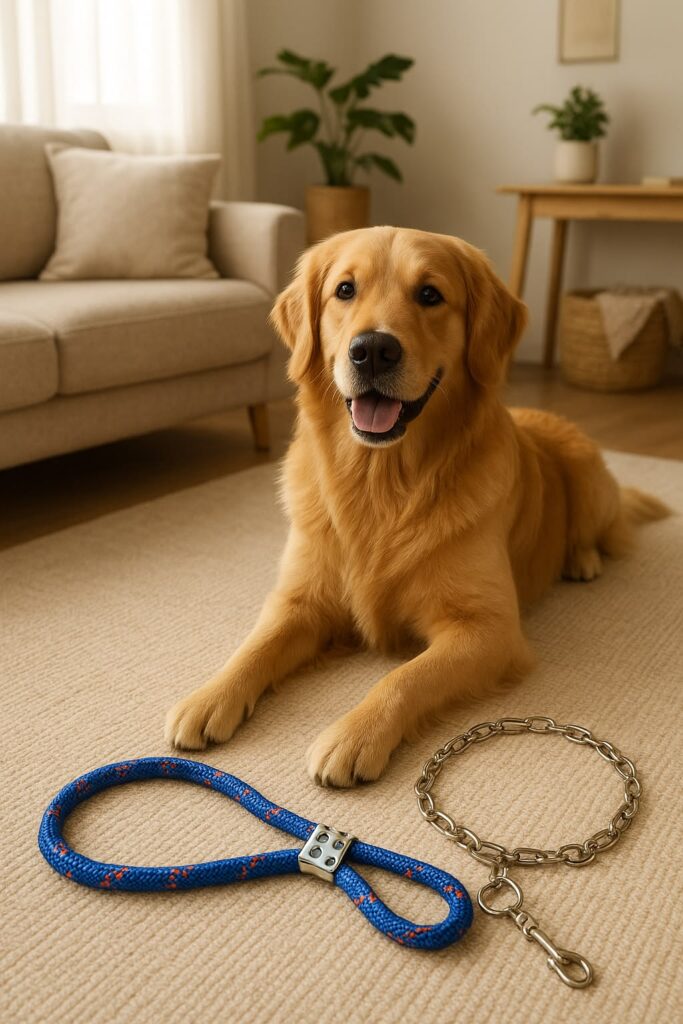
Slip collars, sometimes called choke collars, tighten around a dog’s neck when tension is applied to the leash.
Although they have traditionally been used for leash training, they can create significant pressure around the neck when a dog pulls.
For many family dogs and puppies, there are safer and more comfortable alternatives.
Reward-based loose-leash training can teach a dog to walk without relying on discomfort or neck pressure.
If a slip collar is being considered for a particular training situation, guidance from a qualified, reward-based professional trainer is preferable to experimenting with it independently (dog collar vs harness).
Prong Collars
Prong collars contain metal or other rigid links designed to distribute pressure around the dog’s neck when the leash is pulled.
These collars are controversial because they rely on an aversive sensation to influence behavior.
They can also cause discomfort or injury if incorrectly fitted or used with excessive force.
For most companion dogs, there is little reason to begin training with this type of equipment.
If you are struggling with a strong dog who pulls excessively, consider working with a qualified trainer who uses humane, evidence-based methods before turning to aversive equipment (dog leash training).
Electronic or Shock Collars
Electronic collars can deliver an electrical stimulus, vibration, or other signal controlled remotely.
Some products are marketed as training collars, remote collars, or e-collars.
These tools should not be treated as a quick solution for unwanted behavior.
A dog may stop a behavior because they are experiencing an unpleasant stimulus without actually learning the behavior you want instead.
For example, a dog that receives an unpleasant sensation for barking may become quieter without understanding an appropriate alternative behavior.
Reward-based training focuses on teaching the dog what to do rather than simply suppressing what the owner does not want (loose leash training).
What Is the Best Training Collar for a Puppy?
For most puppies, simplicity is best.
A lightweight, properly fitted buckle collar can be a good starting point for identification and basic collar conditioning.
A comfortable harness can also be useful for leash walking, particularly when you want to minimize pressure around the neck.
If you are raising a Cavapoo puppy, remember that your puppy will grow rapidly. Check the collar and harness fit regularly rather than assuming the same size will remain appropriate.
Our guide to dog harnesses explains how to measure your dog and check the fit properly (positive reinforcement dog training).
Collar vs. Harness for Training
A collar and harness serve different purposes.
A collar provides a convenient place for identification tags and can work well for certain training situations.
A harness distributes leash pressure around the chest and body rather than concentrating it around the neck.
For dogs that pull, a properly fitted harness can provide additional control while reducing direct pressure on the throat.
However, equipment alone does not teach loose-leash walking.
Training remains the most important part of the process.
How to Fit a Training Collar Correctly
A collar should be secure without being restrictive.
As a general starting point, you should be able to comfortably slide approximately two fingers between the collar and your dog’s neck.
The collar should not be so loose that your dog can easily back out of it.
It should also never interfere with breathing, swallowing, normal movement, or comfort.
Check the fit regularly.
Puppies can outgrow collars surprisingly quickly.
Changes in coat length can also affect how a collar fits.
Why Positive Reinforcement Matters
Training is most effective when your dog understands which behavior earns a reward.
Positive reinforcement can involve treats, praise, toys, play, or access to something the dog enjoys.
For example, when teaching your puppy to walk beside you, reward them when they choose to remain near you with a loose leash.
Over time, your puppy learns that staying close produces something rewarding.
This creates a clear connection between the desired behavior and its consequence.
Training Should Teach an Alternative
When your dog displays an unwanted behavior, simply stopping that behavior is not always enough.
Your dog needs to understand what you want them to do instead.
For example:
- Pulling on the leash → reward walking beside you.
- Jumping on guests → reward keeping four paws on the floor.
- Chasing distractions → reward checking in with you.
- Barking for attention → reward calm behavior.
- Running toward the door → reward waiting away from the doorway.
This approach gives your dog a behavior they can successfully repeat.
Don’t Rush Your Dog’s Training
Dogs learn at different speeds.
Some puppies quickly understand basic cues, while others require more repetition.
Training sessions should be short enough to keep your dog engaged.
End sessions on a successful behavior whenever possible.
Avoid becoming frustrated when your dog makes mistakes.
Puppies are still learning how to understand human expectations, their surroundings, and the consequences of their actions.
Patience and consistency are much more valuable than excessive correction.
For additional puppy-training guidance, visit our How to Train a Cavapoo Puppy guide.
Common Mistakes When Choosing a Training Collar
One of the biggest mistakes is selecting equipment based only on the dog’s size.
Your dog’s temperament, body shape, training experience, and walking behavior should also be considered.
Another mistake is assuming that a stronger correction automatically produces better training.
It does not.
A tool that suppresses behavior without teaching an alternative may leave the underlying problem unresolved.
Owners should also avoid using a collar as a substitute for proper exercise and mental enrichment.
A bored or under-stimulated dog may continue displaying unwanted behaviors regardless of the collar being used.
Never Use a Training Collar as a Substitute for Training
A collar is simply equipment.
It cannot teach your dog by itself.
Effective training requires clear communication, repetition, appropriate rewards, and realistic expectations.
If your dog has a serious behavior problem, such as aggression, extreme fear, or dangerous chasing, consult a qualified professional rather than attempting increasingly harsh corrections yourself.
A professional can help identify why the behavior is happening and create a structured training plan.
Training a Cavapoo Puppy
Cavapoos are often eager to interact with their people, making positive reinforcement especially useful during puppy training (Cavapoo training collar).
Start with simple behaviors such as responding to their name, coming when called, sitting, waiting, and walking calmly.
Keep sessions positive.
Use small treats and plenty of praise when your puppy gets something right.
As your puppy becomes more reliable, gradually introduce distractions.
For example, practice walking indoors first, then in a quiet yard, and eventually in more distracting outdoor environments.
This gradual approach can help your puppy understand that the same behavior is expected in different situations.
You can learn more about the breed through our Cavapoo Breed Guide and Cavapoo Care Guide.
How Often Should You Check Your Dog’s Collar?
Check the collar regularly.
You should inspect the fit whenever your puppy grows, gains weight, loses weight, or receives a haircut that significantly changes the amount of coat around the neck (puppy collar).
Also inspect the collar itself.
Look for:
- Frayed material.
- Damaged buckles.
- Broken stitching.
- Damaged leash rings.
- Rust or weakened metal components.
Replace worn equipment before it becomes a safety problem.
Final Thoughts
The best dog training collar is not necessarily the collar that provides the strongest correction.
For most family dogs and puppies, comfortable equipment combined with positive reinforcement is a practical and humane approach to training.
A properly fitted standard collar can be useful for identification and basic training, while a well-fitted harness can provide another option for leash walking (dog training tools).
More restrictive equipment, including choke, prong, and electronic collars, should not be treated as a first-line solution for ordinary puppy training.
Focus on teaching your dog what you want them to do.
With patience, consistency, rewards, and appropriate equipment, your puppy can develop reliable behaviors without relying on fear or pain.
If you’re raising a Cavapoo, continue learning with our How to Train a Cavapoo Puppy and Cavapoo Care Guide resources.
Continue Learning About Cavapoos
- Cavapoo Breed Guide
- Cavapoo Care Guide
- How to Train a Cavapoo Puppy
- Puppy Buying Checklist
- Questions to Ask Before Buying a Cavapoo Puppy
- Health Guarantee
- Shipping & Delivery
- Adoption Process
- Frequently Asked Questions
- Available Cavapoo Puppies
External Authority
- American Kennel Club — Training guidance and dog behavior resources.
- AVSAB — Veterinary behavior guidance on humane, reward-based dog training.
- Humane Society of the United States — Positive-reinforcement training resources.
