
Cavapoo Care Guide, Grooming Guide
Is Your Dog Getting Enough Exercise? A Complete Guide to Healthy Daily Activity
Aug
Exercise is one of the most important parts of keeping your dog healthy, happy, and mentally stimulated (how much exercise does a dog need).
Dogs need regular movement to support their muscles, joints, cardiovascular health, coordination, and healthy body weight. Exercise also gives them an outlet for natural behaviors such as exploring, sniffing, chasing, playing, and learning.
However, how much exercise a dog needs depends on the individual dog.
Age, breed, size, health, fitness level, temperament, and weather can all affect the amount and type of activity that is appropriate.
A young, energetic dog may need considerably more activity than an older companion. A puppy also needs a different exercise routine from a fully grown adult.
For Cavapoo owners, finding the right balance between physical activity, mental enrichment, training, and rest is particularly important during puppyhood.
Why Is Exercise Important for Dogs?
Regular exercise provides benefits that go far beyond burning calories.
Physical activity helps dogs maintain healthy muscles and supports normal mobility. It can also help prevent excessive weight gain when combined with an appropriate diet.
Exercise provides mental benefits too.
Dogs experience boredom when they lack opportunities to explore, interact, learn, and use their natural abilities. A bored dog may look for its own entertainment, which can sometimes result in chewing, digging, barking, jumping, or other unwanted behaviors.
Regular activity can therefore become an important part of a balanced dog-care routine.
Our Cavapoo Care Guide covers additional areas of daily care for Cavapoo puppies and adults.
How Much Exercise Does a Dog Need Every Day?
There is no single exercise requirement that applies to every dog.
The common idea that every dog needs exactly 30 minutes of exercise each day is too simplistic.
Some dogs need much more.
Others, particularly puppies, seniors, or dogs with certain health conditions, may need shorter and more controlled periods of activity.
A better approach is to consider your dog’s individual needs.
Factors That Affect Exercise Requirements
Your dog’s exercise needs can be influenced by:
- Age
- Breed
- Size
- Energy level
- Body condition
- Health
- Temperament
- Fitness level
- Weather
- Type of exercise
- Previous activity level
A Border Collie, for example, generally has very different activity requirements from a senior Chihuahua.
Likewise, a healthy adult Cavapoo may enjoy longer walks than a young Cavapoo puppy that is still developing.
Puppy Exercise Is Different From Adult Dog Exercise
One of the most important mistakes new puppy owners can make is assuming that a puppy should exercise like an adult dog.
Puppies are still growing.
Their bones, joints, muscles, and coordination are developing, so exercise should be age-appropriate and gradually increased.
Instead of pushing a puppy through a long walk, focus on short periods of movement followed by adequate rest.
Puppies can also become overstimulated or overtired.
Sometimes a puppy that appears to have endless energy actually needs a nap rather than more exercise.
How Much Exercise Does a Cavapoo Puppy Need?
Cavapoos are generally playful and people-oriented dogs.
They often enjoy walks, games, training sessions, and exploring their surroundings.
However, your Cavapoo puppy should not be pushed beyond its developmental ability.
Short play sessions can be combined with brief walks, basic training, sniffing games, and supervised exploration.
As your puppy matures, activity can gradually increase.
The goal is not to exhaust your puppy.
The goal is to create a healthy routine that combines movement, mental stimulation, socialization, training, and rest.
For more puppy-specific guidance, see our How to Train a Cavapoo Puppy guide.
Signs Your Dog May Need More Exercise
Some dogs make it obvious when they have excess energy.
Possible signs include:
- Constantly demanding attention
- Restlessness
- Excessive barking
- Destructive chewing
- Digging
- Jumping on people
- Difficulty settling down
- Pacing around the house
- Repeatedly bringing toys to you
- Becoming overly excited during normal activities
These behaviors do not always mean your dog needs more physical exercise.
For example, excessive barking can have many causes, including fear, territorial behavior, excitement, and insufficient training.
If barking is a problem, read our guide on how to stop your dog from barking at strangers.
Signs Your Dog May Be Getting Too Much Exercise
More exercise is not always better.
Your dog may need a break if you notice:
- Excessive or prolonged panting
- Slowing down significantly
- Reluctance to continue
- Limping
- Stiffness after exercise
- Difficulty standing
- Excessive drooling
- Weakness
- Confusion
- Vomiting
- Collapse
If your dog develops severe symptoms during or after exercise, stop the activity and seek veterinary assistance.
Heat-related illness can become an emergency.
The American Kennel Club explains that heatstroke can be life-threatening and requires immediate veterinary attention.
Outdoor Exercise Ideas for Dogs
Outdoor activities provide physical exercise while giving dogs opportunities to experience new sights and smells.
Walking
Walking is one of the simplest ways to exercise your dog.
It provides physical movement while also giving your dog an opportunity to sniff and explore.
Don’t think of a walk as simply covering a certain number of miles.
Allowing your dog to safely stop and sniff can provide valuable mental stimulation.
Fetch
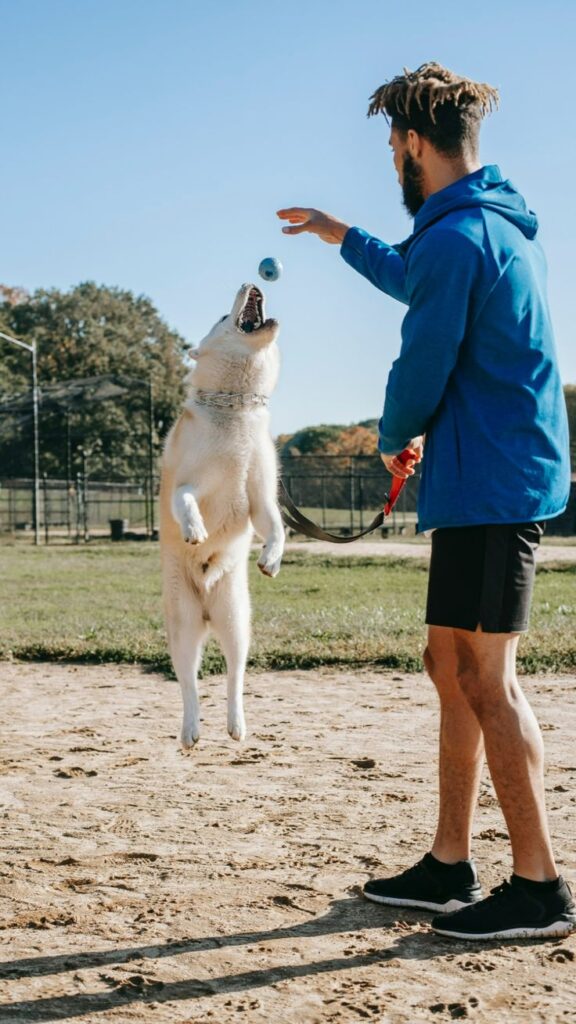
Fetch can provide bursts of running and encourage your dog to chase, retrieve, and interact with you.
However, avoid repeatedly throwing a ball for long periods if your dog becomes exhausted.
Short sessions are often enough.
Exploring New Places
Taking your dog somewhere new can provide both physical and mental enrichment.
Different environments expose your dog to new smells, surfaces, sounds, and sights.
For puppies, new experiences should be introduced gradually and safely.
Supervised Outdoor Play
A secure yard can provide an excellent place for supervised play.
You can combine running with simple training exercises, toys, and games.
However, a yard should not automatically replace walks.
Dogs benefit from experiencing different environments and exploring beyond their normal surroundings.
Indoor Exercise for Dogs
Bad weather does not mean your dog needs to spend the entire day doing nothing.
Indoor activities can provide both physical movement and mental stimulation.
Tug-of-War
Tug can be an enjoyable interactive game when played safely.
Teach your dog an appropriate release cue such as “drop it.”
This can also become a useful training opportunity.
Hide and Seek
Ask your dog to stay while you hide somewhere in the house.
Then call your dog.
Finding you provides mental stimulation and encourages your dog to use its senses.
Indoor Fetch
If you have enough safe space, a short game of fetch can help your dog burn some energy indoors.
Avoid slippery floors and areas containing furniture or objects that your dog could collide with.
Training Games
Training is exercise for the brain.
Practice commands such as:
- Sit
- Down
- Stay
- Come
- Leave it
- Drop it
- Place
- Touch
Short training sessions can be surprisingly tiring for a dog.
Mental Stimulation Is Exercise Too
Physical activity is only one part of keeping a dog active.
Mental enrichment is equally valuable.
Dogs can use their brains through:
- Puzzle toys
- Scent games
- Training
- Food puzzles
- Hide-and-seek
- New environments
- Obedience exercises
- Interactive play
A simple scent game can be especially useful.
Hide several small treats around a safe room and encourage your dog to locate them.
For a Cavapoo, these activities can provide an excellent complement to physical exercise.
Why Sniffing Matters
Dogs experience the world largely through their noses.
Allowing your dog to sniff during walks can provide valuable sensory stimulation.
Instead of rushing through every walk, occasionally allow your dog to investigate safe smells at its own pace.
A five-minute sniffing session can provide a very different type of enrichment from five minutes of running.
This is particularly useful on days when intense physical exercise is not appropriate.
You can learn more about canine scent abilities in our article about your dog’s amazing nose.
Exercise During Hot Weather
Hot weather requires additional caution.
Dogs cannot regulate their body temperature exactly like humans do, and overheating can become dangerous.
Avoid intense exercise during the hottest part of the day.
Instead, consider:
- Early morning walks
- Evening walks
- Shorter outdoor sessions
- Indoor enrichment
- Access to fresh water
- Shaded areas
- Frequent rest breaks
Be particularly cautious with puppies, senior dogs, overweight dogs, and dogs with health conditions.
If your dog develops excessive panting, weakness, vomiting, confusion, collapse, or other concerning symptoms, seek veterinary care immediately.
Keeping Your Dog Hydrated
Fresh water should always be available.
During exercise, your dog may lose fluids through panting and other normal processes.
Bring water when taking your dog on longer outings.
Don’t wait until your dog appears severely thirsty before offering water.
A portable dog water bottle or collapsible bowl can make outdoor trips easier.
Is Exercise Safe in Cold Weather?
Dogs can often enjoy outdoor activity during colder weather, but conditions should be considered.
Ice, snow, freezing temperatures, and salt-treated sidewalks can all create problems.
Check your dog’s paws after outdoor walks.
Look for irritation, cracks, redness, or material trapped between the paw pads.
Some dogs may benefit from properly fitted protective footwear during particularly cold conditions.
Never assume that a thick coat means your dog can safely remain outside indefinitely.
How to Create a Balanced Exercise Routine
A good routine does not need to be complicated.
For an adult dog, you might combine:
Morning: A walk with plenty of safe sniffing.
Afternoon: A short training session or food puzzle.
Evening: Interactive play followed by a relaxed walk.
For a puppy, the sessions should generally be shorter, with plenty of sleep and recovery time between activities.
The exact routine should be adjusted according to your dog’s age, health, energy level, and veterinarian’s recommendations.
Exercise and Positive Training
Exercise can also make training easier.
A dog with an appropriate outlet for energy may be better prepared to focus during training.
However, avoid exercising your dog to exhaustion before every training session.
The objective is to create a dog that can calmly focus, not one that is completely exhausted.
Positive reinforcement can make exercise and training more enjoyable.
Reward the behaviors you want to see and remain consistent with your cues.
Can Exercise Help With Destructive Behavior?
It can help, but exercise should not be treated as a universal cure for behavioral problems.
A dog chewing furniture may need more physical activity.
However, the behavior could also result from anxiety, boredom, teething, lack of supervision, or inadequate training.
Puppies in particular explore the world with their mouths.
Providing appropriate toys, supervision, training, and enrichment is important.
Exercise should therefore be part of a larger routine rather than the only solution.
Exercise and Healthy Weight
Regular activity can support a healthy body weight when combined with appropriate nutrition.
Overweight dogs can experience additional strain on their joints and may have more difficulty exercising.
However, increasing exercise dramatically is not always the best first step for an overweight dog.
Speak with your veterinarian about an appropriate nutrition and exercise plan.
Our Cavapoo Care Guide provides additional information about everyday care.
Frequently Asked Questions
How much exercise does a dog need each day?
There is no universal number.
A dog’s exercise needs depend on its age, breed, health, energy level, fitness, and individual personality.
Some dogs may be comfortable with relatively short daily activity, while high-energy dogs may need substantially more.
Is 30 minutes of exercise enough for a dog?
Thirty minutes can be a useful starting point for some dogs, but it should not be treated as a universal rule.
Your dog’s individual needs matter more than an arbitrary number.
How much exercise does a Cavapoo need?
Cavapoos are generally playful and active companion dogs, but their exercise needs vary.
Puppies should receive shorter, age-appropriate activities with plenty of rest.
Adult Cavapoos can generally participate in regular walks, play, training, and other activities according to their individual fitness and health.
Can puppies exercise too much?
Yes.
Puppies are still developing, so excessive or inappropriate activity can place unnecessary stress on growing bodies.
Short, controlled activities combined with plenty of rest are generally more appropriate than prolonged strenuous exercise.
Should dogs exercise every day?
Most healthy dogs benefit from regular daily activity.
The type and intensity should be adjusted according to the dog’s individual needs and the conditions outside.
What is the best exercise for a dog?
There is no single best exercise.
Walking, playing fetch, training, scent games, swimming where appropriate, and interactive games can all provide useful activity.
Combining physical and mental enrichment is often the best approach.
Can indoor activities replace outdoor walks?
Occasionally, yes.
Bad weather, illness, or other circumstances may make outdoor exercise impractical.
Indoor training, scent games, puzzle toys, and play can provide valuable alternatives.
However, dogs generally benefit from safe opportunities to explore different environments.
How do I know when my dog is tired?
Watch your dog’s body language.
Slowing down, lying down, excessive panting, reluctance to continue, or repeatedly seeking rest can indicate that your dog needs a break.
Never force a tired dog to continue exercising.
Final Thoughts
Exercise is an essential part of responsible dog ownership.
The goal is not to make your dog as tired as possible.
The goal is to provide the right amount of physical activity and mental enrichment for your individual dog.
For puppies, prioritize short and age-appropriate activities, training, exploration, and plenty of rest.
For adult dogs, build a consistent routine around their breed, health, energy level, and personality.
Remember that walking is only one option.
Fetch, training, scent games, interactive toys, indoor activities, and exploring new environments can all contribute to a happy and healthy dog.
For Cavapoo owners, a balanced routine can help your puppy develop healthy habits from an early age.
If you are preparing to bring a Cavapoo home, explore our Available Cavapoo Puppies and learn more about the breed through our Cavapoo Breed Guide.
Continue Learning About Cavapoos
- Cavapoo Breed Guide
- Cavapoo Care Guide
- How to Train a Cavapoo Puppy
- Your Dog’s Amazing Nose
- Cavapoo Puppies by State
- Puppy Buying Checklist
- Questions to Ask Before Buying a Cavapoo Puppy
- Health Guarantee
- Adoption Process
- Frequently Asked Questions
- Available Cavapoo Puppies
Trusted External Resources
For additional information about safe exercise and recognizing heat-related problems, consult trusted veterinary and canine organizations:
- American Kennel Club — Exercising Your Dog
- American Kennel Club — Heatstroke in Dogs
- VCA Animal Hospitals — Exercise and Dogs
Important: This article provides general educational information and does not replace individualized veterinary advice. If your dog has a medical condition, becomes unusually tired during exercise, develops severe panting, collapses, or shows other concerning symptoms, contact your veterinarian.

Pingback: Summer Dog Treats: Easy Homemade Snacks for Your Dog 2026
Pingback: Picking the Best Food for Dogs: A Complete Guide