
Cavapoo Training Guide
Clicker Training 101: How to Train Your Cavapoo With Positive Reinforcement
Aug
Training your dog is one of the best ways to build communication, confidence, and trust (Clicker Training 101).
For Cavapoo owners, training can be especially rewarding. Cavapoos are intelligent, people-oriented dogs that often enjoy learning new behaviors when training is kept positive and engaging.
One simple tool that can make training easier is a clicker.
Clicker training uses a short, consistent sound to tell your dog exactly when they have performed the behavior you want. When that sound is followed by a reward, your dog gradually learns which actions lead to something positive.
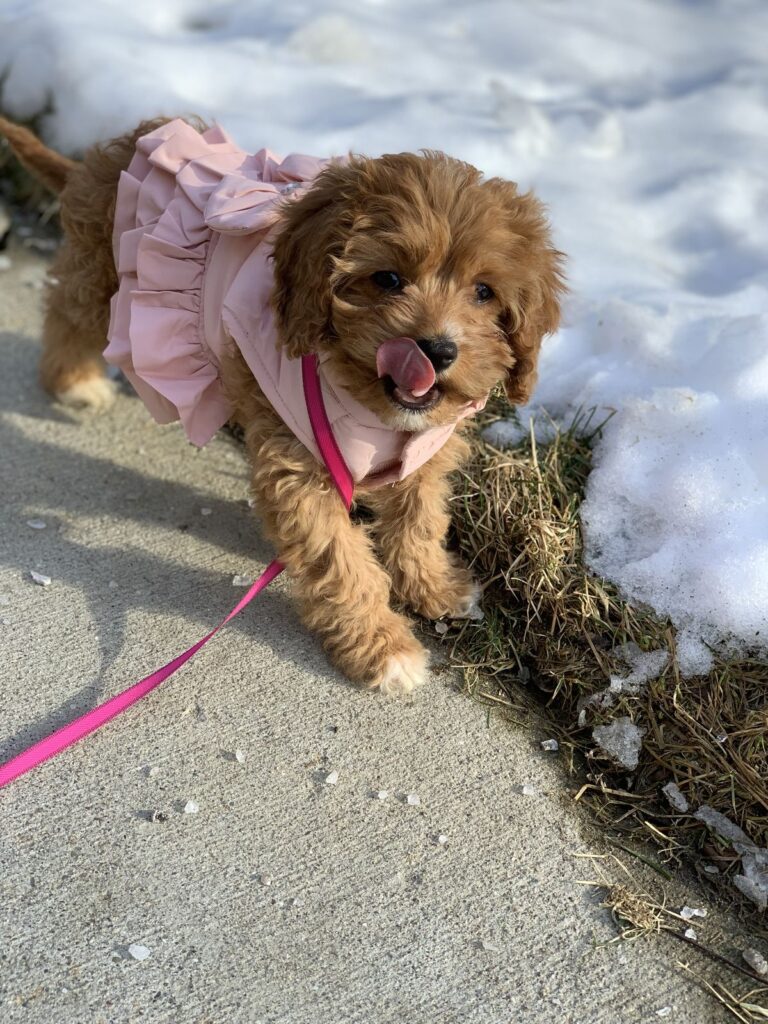
The method can be used with young puppies, adult dogs, and senior dogs.
In this guide, you will learn how clicker training works, how to introduce a clicker, which mistakes to avoid, and how to use positive reinforcement to teach your Cavapoo good manners.
What Is Clicker Training?
A clicker is a small device that produces a distinct clicking sound when pressed.
The click itself is not a command.
Instead, it acts as a marker.
The marker tells your dog:
“That exact behavior is what earned the reward.”
For example, imagine you are teaching your Cavapoo to sit.
You give the verbal cue.
Your dog places their bottom on the floor.
At that exact moment, you click.
You then provide a small reward.
With enough repetition, your dog begins to understand the connection between the behavior and the reward.
This precision is one of the biggest advantages of clicker training.
Your voice can change depending on your mood, surroundings, or excitement. The clicker produces essentially the same marker sound each time.
Clicker Training 101: How Does Clicker Training Work?
Clicker training is based on positive reinforcement.
The basic sequence looks like this:
Behavior → Click → Reward
Your dog performs a behavior.
You immediately mark the behavior with the click.
You then provide a reward.
Eventually, your dog becomes more likely to repeat the behavior because it has been associated with a positive outcome.
The click therefore becomes a bridge between the behavior and the reward.
This is particularly useful when the reward cannot be delivered instantly.
For example, your Cavapoo may sit correctly for only a second. The click allows you to mark that exact moment before you deliver the treat.
Step 1: Charge the Clicker
Before using the clicker to teach commands, your dog needs to learn what the sound means.
This process is often called charging the clicker.
Start somewhere quiet with your dog relaxed.
Click the device.
Immediately give your dog a small treat.
Repeat this process several times.
You are not asking your dog to sit, stay, lie down, or perform another behavior yet.
You are simply teaching:
Click = something good is coming.
Keep the exercise short.
After several repetitions, your dog may begin looking toward you immediately after hearing the click.
That response tells you they are starting to understand the association.
Step 2: Choose a Simple Behavior
Once your Cavapoo understands the click, begin with an easy behavior.
Good beginner behaviors include:
- Sitting
- Looking at you
- Coming toward you
- Touching your hand
- Lying down
- Staying briefly
- Going to their bed
Starting with an easy behavior helps your dog understand the training process without becoming frustrated.
If you are raising a young puppy, this approach works particularly well alongside a consistent Cavapoo puppy training routine.
Step 3: Mark the Exact Moment
Timing is one of the most important parts of clicker training.
Suppose you are teaching your dog to sit.
You give the cue.
Your dog begins lowering their body.
Their bottom touches the ground.
Click.
Then reward.
The click should happen as close as possible to the behavior you want to reinforce.
If you wait several seconds before clicking, your dog may associate the reward with something else.
For example, if you click after your dog stands back up, they may believe that standing is the behavior you wanted.
Good timing makes the training message much clearer.
Step 4: Reward After Every Correct Click
During the early stages of training, the click should normally be followed by a reward.
The reward does not always have to be food.
Depending on your dog, rewards can include:
- Small treats
- Praise
- A favorite toy
- A short game
- Access to something your dog enjoys
Food is often convenient because it can be delivered quickly.
When using treats, keep portions small so your dog’s training calories do not become excessive.
This is especially important for smaller breeds such as Cavapoos.
Why Clicker Training Works
Clicker training provides several advantages.
Precision
The click identifies the exact moment your dog performs the desired behavior.
Consistency
The click sounds similar each time.
Positive Learning
The method focuses on rewarding behaviors you want rather than punishing mistakes.
Better Communication
Your dog gradually learns which actions produce rewards.
Increased Engagement
Short training exercises can give dogs a mentally stimulating activity.
For an intelligent and social breed like the Cavapoo, mental stimulation can be an important part of a balanced daily routine.
When Should You Start Clicker Training?
You can begin basic positive-reinforcement training when your puppy comes home, provided the sessions are age-appropriate and your puppy is comfortable.
Young puppies have short attention spans.
They do not need long training sessions.
Instead, focus on very short exercises that end while your puppy is still interested.
A young Cavapoo can begin learning simple behaviors such as responding to their name, looking toward you, sitting, coming when called, and settling calmly.
Training should gradually become more challenging as your puppy develops.
If you are preparing to bring home a Cavapoo, understanding the Cavapoo puppy adoption process can also help you prepare for the training and adjustment period that follows.
Can You Clicker Train an Adult Dog?
Absolutely.
Clicker training is not limited to puppies.
Adult dogs can learn new behaviors throughout their lives.
An older dog may already understand basic commands, but clicker training can help refine those behaviors or teach completely new skills.
It can also provide mental stimulation.
If your adult Cavapoo already knows how to sit, you can move on to more advanced behaviors such as:
- Waiting politely
- Going to a designated bed
- Walking calmly
- Touching a target
- Coming when called
- Remaining in position
- Performing tricks
The most important ingredients are patience and consistency.
Do You Need Obedience School?
No.
You can practice basic clicker training at home.
A quiet home environment may actually be helpful when your dog is first learning how the clicker works.
However, professional training can be valuable in certain situations.
Consider working with a qualified positive-reinforcement trainer if:
- You are new to dog training.
- Your dog becomes easily distracted.
- Your dog displays significant fear or anxiety.
- Your puppy struggles with socialization.
- Your dog shows aggressive behavior.
- You need help with complex training problems.
- You want to progress beyond basic obedience.
Group classes can also provide controlled opportunities for appropriate socialization when conducted by experienced professionals.
Clicker Training at Home
You do not need a complicated setup.
Choose a quiet area where your dog can focus.
Have your clicker and rewards ready before beginning.
Start with a simple goal.
For example:
Goal: Teach “sit.”
- Hold a small reward near your dog’s nose.
- Move the reward slightly upward and backward.
- As your dog’s bottom reaches the floor, click.
- Immediately provide the reward.
- Repeat several times.
- Introduce the verbal cue once your dog begins understanding the behavior.
- Practice in short sessions.
Do not keep repeating the command if your dog does not understand it.
Instead, make the exercise easier and help your dog succeed.
How Long Should Clicker Training Sessions Be?
Short sessions are usually better than long sessions.
For a puppy, even a few minutes can be enough.
A useful approach is to train several times throughout the day rather than expecting your dog to concentrate for a long period.
For example:
Morning: 3–5 minutes
Afternoon: 3–5 minutes
Evening: 3–5 minutes
The exact duration should depend on your individual dog.
If your Cavapoo becomes distracted, frustrated, tired, or stressed, end the session and try again later.
Training should be enjoyable.
Common Clicker Training Mistakes to Avoid
Clicker training is simple, but timing mistakes can make learning harder.
1. Using the Clicker as a Command
The clicker is not a remote control.
It does not tell your dog to sit, stay, come, or stop.
It marks a behavior that has already happened.
2. Clicking Without a Reward
Especially during the early stages, avoid clicking repeatedly without following the marker with the expected reward.
Your dog needs to maintain the association between the click and positive reinforcement.
3. Clicking Too Late
Timing matters.
If your dog performs the desired behavior and you wait too long before clicking, you may accidentally reinforce something else.
4. Clicking Randomly
Do not click simply because your dog is looking at you or because you want their attention.
The click should have meaning.
5. Using the Clicker to Correct Your Dog
The clicker should not be used to scare, startle, or punish your dog.
Positive reinforcement works by strengthening behaviors you want to see repeated.
6. Training for Too Long
Long sessions can cause your dog to lose interest.
Short, successful sessions are often more productive.
7. Expecting Immediate Results
Every dog learns at a different pace.
Some behaviors may develop quickly.
Others require many repetitions.
Do not become frustrated if your dog does not master a new behavior immediately.
8. Ignoring Your Dog’s Body Language
Your dog should appear comfortable during training.
If your Cavapoo becomes overwhelmed, nervous, tired, or frustrated, give them a break.
A successful training program should build confidence rather than create unnecessary stress.
When Should You Stop Using the Clicker?
The clicker does not necessarily need to remain part of every training session forever.
Once your dog reliably performs a behavior, you can gradually reduce your dependence on the clicker.
For example, your dog may initially require:
Cue → Behavior → Click → Treat
Eventually, you may transition toward:
Cue → Behavior → Praise/Reward
The clicker can remain useful for teaching new or more complicated behaviors.
Think of it as a training tool rather than something your dog must depend on permanently.
Clicker Training and Cavapoo Puppies
Cavapoos can be wonderful candidates for positive-reinforcement training because many are highly motivated by interaction with their owners.
However, every Cavapoo has an individual personality.
Some puppies may be highly food motivated.
Others may respond more strongly to toys, praise, attention, or play.
Pay attention to what motivates your puppy.
A training session should feel like an enjoyable game rather than a chore.
This can also strengthen the relationship between you and your puppy.
If you are still choosing your puppy, our Available Cavapoo Puppies page is the place to explore the puppies currently available.
Clicker Training Beyond Basic Commands
Once your dog understands the concept, clicker training can be used for much more than “sit.”
You can gradually teach:
Recall
Reward your dog for turning toward you and eventually coming when called.
Loose-Leash Walking
Mark moments when your dog walks beside you without pulling.
Place Training
Reward your dog for calmly going to and remaining on a designated bed or mat.
Handling
Reward calm behavior while you gently touch your dog’s paws, ears, coat, and other areas.
This can make routine grooming and veterinary handling easier.
Our Cavapoo grooming guide can be useful alongside this type of cooperative handling practice.
Tricks
Once basic behaviors are established, you can teach fun tricks such as:
- Spin
- Paw
- Touch
- Wave
- Crawl
- Find it
- Targeting
Mental challenges can help keep an intelligent dog engaged.
Frequently Asked Questions About Clicker Training
Is clicker training good for Cavapoos?
Yes.
Clicker training can be a useful positive-reinforcement method for Cavapoos.
The click gives your dog a clear signal when they have performed the behavior you want.
However, training success depends more on consistency, timing, motivation, and the individual dog’s temperament than on the breed alone.
Can I use clicker training without treats?
Eventually, yes.
Treats are particularly useful while establishing new behaviors because they provide a clear reward.
Once a behavior becomes reliable, you can gradually vary the rewards and incorporate praise, play, toys, and other forms of reinforcement.
What if my dog is afraid of the clicker?
Some dogs may find a sharp click startling at first.
If your dog reacts negatively, increase the distance between the clicker and your dog or use a softer marker.
You can also consider a verbal marker such as a short, consistent word.
Never force a frightened dog to continue.
Can I click more than once?
For beginners, it is usually better to make one clear click for the behavior you want to mark.
Multiple rapid clicks can become confusing if your dog does not understand what they mean.
Keep the marker clear and consistent.
How many treats should I use?
There is no universal number.
Use very small treats and account for training rewards as part of your dog’s overall daily food intake.
For small dogs such as Cavapoos, tiny pieces are often sufficient.
Can clicker training stop bad behavior?
Clicker training is primarily used to teach and strengthen desirable behaviors.
Instead of focusing only on stopping unwanted behavior, identify the behavior you want your dog to perform instead.
For example, instead of repeatedly correcting jumping, reward your dog for keeping all four paws on the floor when greeting people.
This gives your dog a clear alternative.
Final Thoughts: Build Better Behavior Through Positive Reinforcement
Clicker training is a simple tool, but its effectiveness comes from how you use it.
The goal is not to make your dog obey through fear.
The goal is to communicate clearly and reward behaviors you want repeated.
Keep sessions short.
Use good timing.
Reward generously during the learning stage.
Pay attention to your dog’s comfort.
And most importantly, be patient.
Whether you are teaching a young Cavapoo puppy their first command or helping an adult dog learn a new trick, positive reinforcement can make training more enjoyable for both of you.
With consistency and encouragement, those small training sessions can become some of the most rewarding moments you share with your dog.
More Cavapoo Training & Care Resources
Training is only one part of raising a happy and well-adjusted Cavapoo.
Explore our Cavapoo Puppy Training resources for additional guidance on teaching good manners and building reliable habits.
You can also learn more about Cavapoo puppies for sale and our Cavapoo puppy adoption process if you are preparing to welcome a new puppy into your family.
For everyday care, continue with our Cavapoo grooming resources and other puppy-care guides.
Responsible Pet Care Disclaimer
This article provides general educational information and should not replace professional training or veterinary advice. Every dog has a different temperament, learning history, and individual needs. If your dog displays serious fear, anxiety, aggression, or other concerning behavior, work with a qualified professional who uses humane, evidence-based training methods.
