
Cavapoo Locations
How to Prepare Your Apartment for a Cavapoo Puppy: Complete Guide
Oct
Bringing home a Cavapoo puppy is exciting, but preparing your living space before your puppy arrives can make those first few weeks much easier. Apartment living can work very well for a Cavapoo when the puppy has appropriate exercise, training, mental stimulation, a safe environment, and a consistent daily routine.
A smaller home does not automatically mean a puppy will be unhappy. What matters is how you use the space and how well you meet your puppy’s physical, behavioral, and social needs.
If you’re searching for Cavapoo Puppies For Sale Near Me, preparing your apartment before choosing or bringing home your puppy is one of the smartest steps you can take. A prepared home gives your puppy a secure place to settle while giving you a better foundation for house training, crate training, grooming, feeding, and everyday care.
Whether you live in a studio, condominium, apartment, or larger multi-unit building, these practical steps can help you prepare for your new Cavapoo puppy.
1. Check Your Apartment’s Pet Rules Before Bringing Home a Puppy
Before purchasing supplies or choosing a puppy, review your lease and speak with your landlord or property manager.
Apartment communities can have different policies regarding pets. Some may limit the number of animals, require a pet deposit or monthly pet fee, establish weight restrictions, or have restrictions involving particular breeds. Others may require vaccination records, renter’s insurance, registration, or documentation from the owner.
Do not assume that because a Cavapoo is a small companion dog, every apartment automatically allows one.
Ask specifically about:
- Pet approval requirements
- Weight or size restrictions
- Breed restrictions
- Number of pets permitted
- Pet deposits or monthly fees
- Elevator or common-area rules
- Leash requirements
- Designated pet-relief areas
- Noise policies
- Vaccination requirements
- Building rules regarding barking or disturbances
Getting written confirmation can be especially helpful.
If you are moving into a new apartment, make sure the building is genuinely suitable for a puppy rather than simply allowing dogs. A pet-friendly building may still have rules that affect how you exercise, potty train, or socialize your puppy.
2. Create a Dedicated Puppy Area
Your Cavapoo does not need an entire apartment to explore immediately.
In fact, giving a new puppy unrestricted access to an unfamiliar home can make training more difficult. A smaller, carefully prepared area allows your puppy to gradually become comfortable with the new environment.
Choose an area that is easy to clean and relatively free from hazards. Depending on your apartment layout, this could be part of a living room, kitchen, bedroom, or another suitable area.
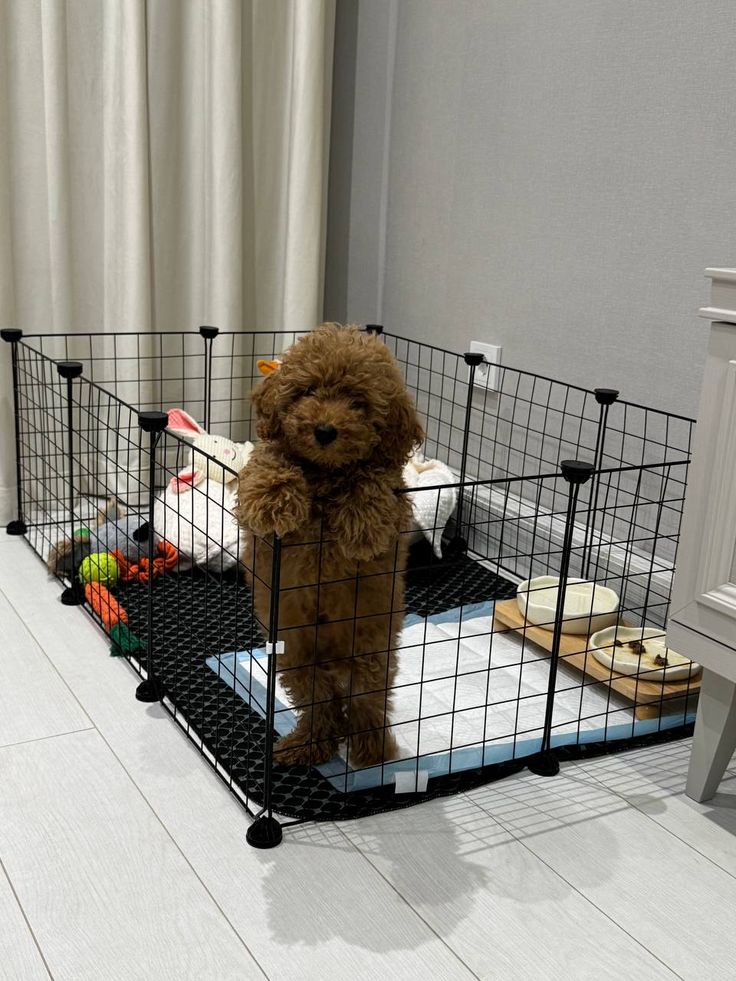
Your puppy’s space can include a comfortable bed, crate, water bowl, appropriate toys, and safe enrichment activities.
A puppy pen can also be useful for creating boundaries when you cannot provide direct supervision.
As your Cavapoo becomes more reliable with potty training and learns the household rules, you can gradually increase access to other areas of the apartment.
3. Puppy-Proof the Apartment Before Your Cavapoo Arrives
Puppies investigate the world with their mouths, noses, paws, and teeth. Items that seem harmless to you can become dangerous when a curious puppy starts exploring.
Walk through your apartment from your puppy’s perspective and look for potential hazards.
Secure electrical cords, keep small objects off the floor, move medications and cleaning products out of reach, and make sure trash cans are securely closed.
Pay particular attention to:
- Electrical cables
- Charging cords
- Small toys or objects
- Medications
- Cleaning chemicals
- Human foods
- Houseplants
- Loose strings
- Plastic packaging
- Accessible trash
- Open windows
- Balconies
- Small gaps behind furniture
- Items that can be knocked over
Do not rely solely on your puppy’s intelligence or good behavior. Management is an important part of puppy training.
If your apartment has a balcony, make sure your puppy cannot squeeze through railings or access unsafe edges. Never assume a puppy will understand the danger of an elevated area.
For additional preparation ideas, see our guide on how to puppy-proof your home.
4. Choose the Right Crate and Introduce It Positively
A crate can be a useful tool for apartment living when introduced correctly.
The goal is for your Cavapoo to view the crate as a safe resting area rather than as punishment.
Choose a crate that gives your puppy enough room to stand up, turn around, lie down comfortably, and change positions. A crate that is excessively large may make house training more difficult for some puppies because the puppy may use one end as a bathroom.
Introduce the crate gradually.
Place comfortable bedding or another suitable resting surface inside, provide appropriate enrichment, and allow your puppy to investigate it voluntarily. You can reward calm behavior around the crate and gradually build positive associations.
Never use the crate as a place to punish your puppy.
Crate training can be particularly helpful in an apartment because it gives your puppy a predictable sleeping and resting location while helping you manage periods when you cannot supervise directly.
However, a crate should not become a substitute for exercise, interaction, training, or appropriate potty breaks.
5. Prepare for Potty Training Before Your Puppy Arrives
Potty training can require additional planning in an apartment because you may need to travel through hallways, use elevators or stairs, and reach a designated outdoor area.
Know exactly where you will take your puppy before the first day.
Identify the nearest appropriate potty area and determine the fastest route from your apartment to that location.
During the early stages of house training, timing matters. Young puppies may need frequent opportunities to eliminate, particularly after waking, eating, drinking, playing, and sleeping.
Watch for signs that your puppy needs to go, such as sniffing, circling, restlessness, or suddenly moving away from an activity.
When your puppy eliminates in the correct location, provide immediate praise or an appropriate reward.
Accidents are normal during puppyhood. Consistency and supervision are much more productive than punishment.
If you want a broader preparation checklist, our Cavapoo Puppy Buying Guide and Puppy Buying Checklist can help you organize the next steps.
6. Find a Safe Place for Daily Exercise
Apartment living does not eliminate a Cavapoo’s need for physical activity.
However, exercise should be appropriate for your puppy’s age, health, vaccination status, weather conditions, and individual development.
Before bringing your puppy home, identify several suitable places where you can walk and explore together.
A nearby park can be useful, but a park is not automatically appropriate for every young puppy. Disease exposure, vaccination status, traffic, unfamiliar dogs, heat, and other environmental factors should be considered.
Your veterinarian can help you determine when and where your puppy can safely participate in outdoor activities and interact with unfamiliar dogs.
You can also provide appropriate activity inside your apartment through short training sessions, gentle play, food puzzles, scent games, and other forms of enrichment.
The objective is not to exhaust your puppy. It is to provide an appropriate combination of movement, exploration, training, rest, and mental stimulation.
7. Stock Up on Appropriate Puppy Toys
A puppy needs appropriate things to chew, explore, and play with.
Providing suitable toys can help direct your Cavapoo toward acceptable activities instead of household furniture, shoes, electrical cords, or other objects.
Consider having several types of enrichment available, including:
- Puppy-safe chew toys
- Food-stuffable enrichment toys
- Soft toys designed for supervised play
- Puzzle toys
- Training treats
- Interactive toys
- Toys that encourage appropriate chewing
Rotate toys rather than leaving every toy available at once. This can make familiar toys more interesting and gives you opportunities to introduce different forms of enrichment.
Always inspect toys regularly for damage and remove items that become small enough to swallow or that begin breaking apart.
Interactive toys should not automatically be considered safe for unsupervised use. Follow the manufacturer’s guidance and consider your individual puppy’s chewing habits.
Mental stimulation is particularly valuable in an apartment because a puppy’s enrichment does not have to depend entirely on having a large yard.
8. Choose Puppy Food With Your Veterinarian’s Guidance
Nutrition is one of the most important parts of preparing for a growing Cavapoo.
Instead of simply looking for food advertised as “high quality,” choose a complete and balanced puppy diet appropriate for your puppy’s life stage and individual needs.
Your veterinarian can help you select an appropriate diet and feeding schedule.
Do not assume that a puppy food should simply be low in fat and sugar and high in protein. Puppy nutrition is more complicated than comparing a few ingredients on the front of a package.
Your puppy’s nutritional needs can depend on factors such as age, expected adult size, health, activity level, and individual circumstances.
Before your Cavapoo arrives, ask what food the puppy is currently eating. Keeping the initial diet consistent can make the transition easier. If you want to change foods, a gradual transition is generally preferable to suddenly switching diets.
Keep fresh drinking water available and establish regular feeding routines.
9. Prepare for Apartment Noise
One of the biggest differences between apartment living and a detached home is the amount of sound your puppy may hear.
Elevators, footsteps, doors closing, neighbors, televisions, traffic, alarms, other dogs, and people walking through hallways can all become part of your puppy’s environment.
Instead of expecting your Cavapoo to immediately ignore every sound, use gradual positive exposure.
When your puppy notices a normal household sound and remains relaxed, pair the experience with something positive. Keep exposures manageable and avoid deliberately overwhelming your puppy.
The goal is to help your puppy learn that ordinary apartment noises do not always require a reaction.
If your puppy begins barking, do not simply punish the barking. Look at what triggered it and work on changing your puppy’s response through appropriate training and management.
10. Plan for Separation and Alone Time
A puppy needs companionship, but it also needs to gradually learn how to settle when you are not constantly interacting.
This is particularly important for apartment residents who work outside the home.
Start with short, manageable periods of separation rather than expecting a young puppy to immediately remain alone for an extended period.
Provide a safe environment and appropriate enrichment, and build independence gradually.
Avoid suddenly leaving a puppy alone for an entire workday without a plan for potty breaks, exercise, feeding, and interaction.
Depending on your schedule, you may eventually need help from a trusted family member, dog walker, pet sitter, or other appropriate caregiver.
Learning to relax independently is a skill that can be developed gradually.
11. Prepare Your Elevator, Stairs, and Hallways Routine
Apartment puppies have to navigate shared spaces that puppies in detached homes may encounter less often.
Before your puppy arrives, think about how you will get outside for potty breaks and walks.
If you use an elevator, your puppy may encounter unfamiliar people, dogs, sounds, and sudden movements. Keep your puppy safely controlled and avoid forcing interactions.
If you use stairs, consider your puppy’s age, size, confidence, and physical development. Very young puppies may need to be carried in some situations.
You should also become familiar with your building’s rules about leashes, common areas, elevators, and pet relief zones.
Having a predictable routine makes apartment life easier for both you and your puppy.
12. Buy the Essential Supplies Before Pickup Day
Preparing supplies ahead of time means you can focus on helping your puppy settle in rather than making multiple emergency shopping trips.
Your basic Cavapoo puppy setup may include:
- Appropriately sized crate
- Puppy-safe bed
- Food and water bowls
- Complete puppy food
- Collar or harness
- Identification tag
- Leash
- Puppy-safe toys
- Training treats
- Enzymatic cleaner for accidents
- Waste bags
- Grooming brush and comb
- Puppy shampoo if recommended
- Nail-care supplies
- Puppy gates or pen
- Appropriate travel carrier or restraint
- Cleaning supplies
- First-aid supplies recommended by your veterinarian
You do not need to purchase every possible puppy product before bringing your dog home. Start with the essentials and add items as you learn your puppy’s individual preferences and needs.
13. Prepare a Grooming Routine Early
Cavapoos can have coats that require regular grooming and maintenance.
The earlier your puppy learns that brushing, handling, paw checks, ear checks, and other routine care can be calm and rewarding experiences, the easier these activities may become later.
Keep early grooming sessions short.
Reward your puppy for calmly allowing gentle handling of different areas of the body. Do not force prolonged grooming sessions when your puppy is frightened or overwhelmed.
A professional groomer can eventually become an important part of your Cavapoo’s care routine.
For more information, read our guide to Cavapoo grooming and coat care.
14. Establish a Daily Apartment Routine
Puppies generally benefit from predictable routines.
Your schedule does not have to be identical every day, but your Cavapoo should have regular opportunities for sleeping, eating, potty breaks, training, play, enrichment, grooming practice, and calm time.
A simple day might include waking up, a potty break, breakfast, another potty opportunity, a short training session, play or exploration, rest, and repeated potty opportunities throughout the day.
Young puppies also need substantial sleep.
Do not interpret every period of rest as a sign that your puppy needs more exercise. Rest is an important part of healthy puppy development.
15. Make Your Apartment a Calm, Safe Home
One of the biggest advantages of preparing your apartment before your Cavapoo arrives is that you can create a calm environment from the beginning.
Your puppy does not need constant excitement.
A comfortable sleeping area, predictable routine, appropriate enrichment, positive training, safe socialization, and time with you can provide a strong foundation.
Apartment living can be an excellent fit for a Cavapoo when the household is prepared to meet the dog’s needs.
The key is not simply the number of square feet in your apartment. It is the quality of the puppy’s daily life.
Is a Cavapoo a Good Dog for Apartment Living?
Cavapoos can be well suited to many apartment households because they are relatively small companion dogs and can adapt to different living environments.
However, being small does not mean that a Cavapoo requires no exercise or training.
A Cavapoo still needs regular movement, mental stimulation, socialization, grooming, companionship, and training.
The best apartment environment is one where the owner has enough time and commitment to meet those needs.
If you are considering Cavapoo Puppies For Sale In Tennessee, for example, your decision should include more than simply finding a puppy. Consider your apartment rules, schedule, access to appropriate outdoor areas, transportation, veterinary care, grooming options, and ability to provide daily companionship.
The same applies if you are considering Cavapoo Puppies For Sale In Ohio or Cavapoo Puppies For Sale In Florida. Climate, housing rules, local veterinary resources, and your personal routine can all affect how you care for a puppy.
Apartment Living With a Cavapoo: What Matters Most
A successful apartment puppy experience usually comes down to preparation and consistency.
Your Cavapoo needs a safe place to sleep, appropriate food, regular potty opportunities, age-appropriate exercise, positive training, enrichment, grooming, veterinary care, and plenty of appropriate rest.
You also need to think about the practical realities of apartment life. Can you take your puppy outside frequently enough during house training? Can you manage the puppy’s schedule around work? Can you provide appropriate exercise without relying entirely on a backyard? Are you prepared for the possibility of barking, chewing, accidents, and interrupted sleep during puppyhood?
Answering these questions before bringing your puppy home can prevent many avoidable problems.
Final Thoughts: Preparing Your Apartment for a Cavapoo Puppy
Preparing an apartment for a Cavapoo puppy is about much more than buying a crate and a few toys.
The best preparation combines a safe physical environment with realistic expectations about puppy behavior.
Review your building’s pet rules, puppy-proof the apartment, establish a dedicated puppy area, prepare for potty training, introduce a crate positively, choose appropriate food, stock up on safe enrichment, plan outdoor activities, and establish a predictable routine.
Most importantly, give your puppy time to adjust.
The first days and weeks are a learning period for both of you. With patience, positive reinforcement, supervision, and consistent routines, your apartment can become a comfortable and enriching home for your Cavapoo.
If you’re currently searching for Cavapoo Puppies For Sale Near Me, you can start by viewing Atlantic Cavapoo Puppies’ available puppies and learning more about the adoption process before making your decision.
Frequently Asked Questions About Cavapoos in Apartments
Can a Cavapoo live comfortably in an apartment?
Yes. Many Cavapoos can adapt well to apartment living when their needs for exercise, enrichment, training, companionship, grooming, and rest are met.
Do Cavapoos need a backyard?
No. A backyard can be convenient, but it is not essential. Apartment owners can provide appropriate exercise and potty opportunities through walks, outdoor exploration, training, play, and enrichment.
How do I puppy-proof an apartment?
Secure electrical cords, medications, cleaning products, toxic foods, trash, small objects, unsafe plants, windows, balconies, and other potential hazards. Limit access until your puppy becomes more reliable.
Is crate training useful for an apartment puppy?
It can be. A properly introduced crate can provide a safe resting space and help owners manage supervision and house training. It should never be used as punishment or as a substitute for exercise and interaction.
How often does an apartment puppy need to go outside?
Young puppies generally need frequent potty opportunities, particularly after waking, eating, drinking, playing, and sleeping. The exact schedule depends on age and individual development.
What if my apartment does not have a yard?
That is not necessarily a problem. Plan regular outdoor potty breaks and age-appropriate walks, and supplement them with indoor enrichment and training.
How can I stop my Cavapoo from barking at apartment noises?
Identify the trigger, manage the environment, and use gradual positive exposure and reward-based training. Avoid assuming that punishment is the best solution.
Can a Cavapoo be left alone in an apartment?
A puppy should not suddenly be expected to remain alone for long periods. Alone time should be introduced gradually, with appropriate potty breaks, enrichment, exercise, and care arrangements.
What toys are best for a Cavapoo puppy?
Look for puppy-appropriate toys designed for safe chewing and enrichment. Food-stuffable toys, puzzle toys, and appropriately sized chew toys can provide useful mental stimulation. Always supervise according to the toy’s design and your puppy’s chewing habits.
Should I take my Cavapoo puppy to a dog park?
Not necessarily. Young puppies may have vaccination and disease-exposure considerations, and not every dog park is appropriate for every puppy. Ask your veterinarian about safe socialization and outdoor activities.
How much exercise does an apartment Cavapoo need?
There is no single exercise amount that applies to every Cavapoo. Puppies need age-appropriate activity balanced with plenty of rest. Your veterinarian can help you determine an appropriate routine.
What should I feed my Cavapoo puppy?
Feed a complete and balanced puppy diet appropriate for your puppy’s life stage and individual needs. Your veterinarian can help you choose an appropriate food and feeding schedule.
Do Cavapoos shed in apartments?
Cavapoo coats vary because they are a Cavalier King Charles Spaniel and Poodle cross. Some may shed relatively little, while others may shed more. Regular brushing and grooming are important regardless of coat type.
How can I make my apartment comfortable for my new puppy?
Create a quiet puppy area with a safe resting space, appropriate toys, food and water, and easy access to the items you need for training and care.
Is apartment living bad for puppies?
No. The size of a home is only one part of a puppy’s environment. Exercise, enrichment, socialization, training, companionship, safety, and appropriate rest are all important.
Continue Learning About Cavapoos
If you’re preparing to bring a Cavapoo into your home, continue learning with these Atlantic Cavapoo Puppies resources:
Available Cavapoo Puppies — Explore current puppies and learn more about choosing your next companion.
Cavapoo Breed Guide — Learn about Cavapoo characteristics, temperament, size, grooming, and general care.
Cavapoo Care Guide — Explore practical information for caring for a Cavapoo throughout puppyhood and beyond.
Cavapoo Buying Guide — Learn what to consider before choosing a Cavapoo puppy.
Cavapoo Puppies by State — Explore Cavapoo information and availability for different U.S. locations.
Puppy Buying Checklist — Review important considerations before bringing a puppy home.
Questions to Ask Before Buying a Cavapoo Puppy — Know what questions to ask before making a puppy purchase.
Health Guarantee — Review Atlantic’s information about its puppy health guarantee.
Shipping & Delivery — Learn about the options available for getting your puppy home safely.
Adoption Process — Follow the steps involved in choosing and bringing home a Cavapoo puppy.
Frequently Asked Questions — Find answers to common Cavapoo puppy questions.
