Cavapoo Care Guide
How to Prepare Your Apartment for a Cavapoo Puppy This Fall
Sep
Fall can be a wonderful time to welcome a Cavapoo puppy into your home (Cavapoo puppy apartment).
The weather gradually becomes cooler, outdoor routines can become more comfortable, and there are plenty of opportunities to establish new walking, training and family routines before winter arrives.
But bringing a puppy into an apartment requires preparation.
A puppy doesn’t automatically understand which areas are safe, where they should sleep, where they should eliminate, what they are allowed to chew, or how to behave when they hear neighbors in the hallway.
Your apartment may feel completely ready to you, but from a puppy’s perspective, it is a brand-new environment filled with unfamiliar sounds, smells, surfaces and objects.
The good news is that you don’t need a huge house or a private backyard to give a Cavapoo puppy a comfortable home.
Cavapoos are adaptable companion dogs and can live successfully in homes ranging from apartments to larger houses when their needs are properly met. PetMD describes Cavapoos as friendly, playful companion dogs that generally need light-to-moderate exercise rather than vigorous endurance activity.
The key is preparation.
Good Cavapoo puppy preparation means thinking about safety, potty training, exercise, enrichment, grooming, socialization and rest before your puppy arrives.
Here is how to prepare your apartment for a Cavapoo puppy this fall.
1. Create a Dedicated Puppy Area
Before your puppy arrives, decide where they will spend most of their unsupervised time.
Your puppy does not need access to the entire apartment immediately.
In fact, giving a young puppy complete freedom can make house training, chewing management and supervision much harder.
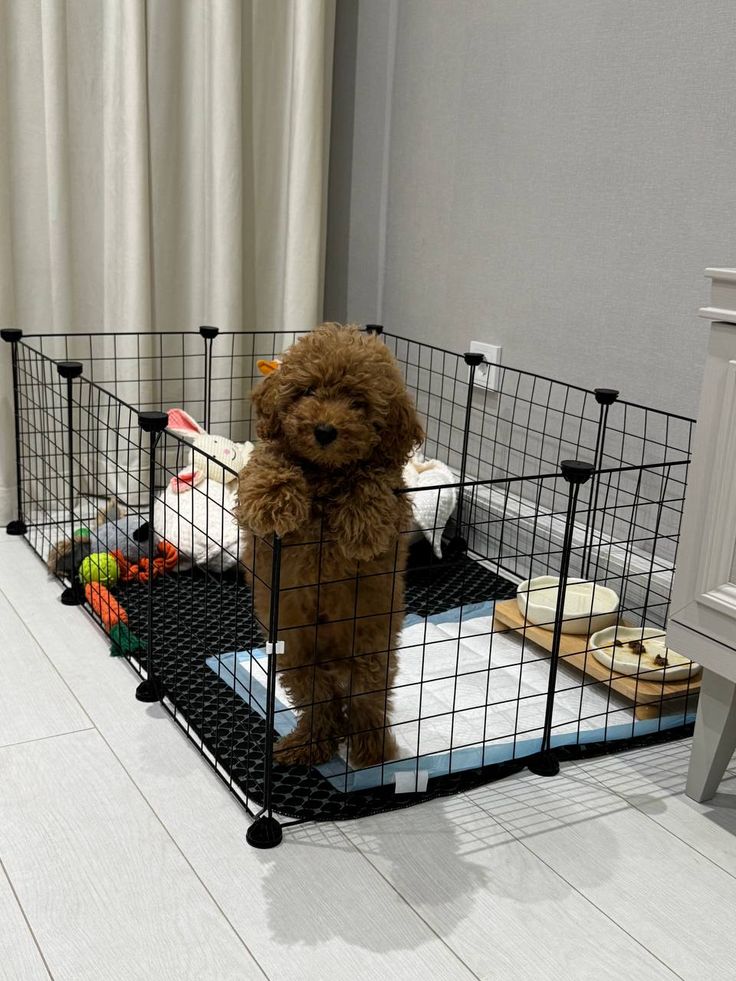
Instead, create a safe puppy area using an appropriately sized crate, exercise pen or baby gates.
This is one of the most important apartment puppy tips for new owners because a smaller, controlled area makes it easier to supervise your puppy.
This area can contain:
- a comfortable resting space
- the puppy’s crate
- appropriate chew toys
- safe enrichment toys
- food and water as appropriate
- a washable surface
- easy access for you to supervise
The goal isn’t to isolate your puppy.
It is to give them a predictable, manageable environment while they learn the rules of their new home.
The AKC recommends crates, exercise pens and gates as management tools while puppies are learning household manners and potty training.
As your puppy becomes more reliable with potty training and household manners, you can gradually increase their freedom.
2. Puppy-Proof Your Apartment Before Arrival
Puppy-proofing is especially important in an apartment because many household objects are within easy reach.
Good Cavapoo puppy proofing starts by looking at your home from a puppy’s perspective.
What could be chewed?
What could be swallowed?
What could be knocked over?
What could become dangerous if your puppy decided to investigate it?
Secure electrical cords.
Move medications out of reach.
Store cleaning products safely.
Keep small objects off the floor.
Secure trash cans.
Keep houseplants away from curious teeth unless you have confirmed that they are safe for dogs.
Move food away from accessible countertops.
Keep shoes and clothing out of reach.
Check balconies and windows carefully.
A puppy can be surprisingly creative when exploring.
Something that appears harmless to an adult may become a chewing or swallowing hazard to a young dog.
Preventing access is much easier than trying to teach a puppy not to investigate every dangerous object.
The AKC also identifies puppy-proofing and appropriate chewing habits as important parts of early puppy training and safety.
3. Prepare a Safe Crate for Your Cavapoo
Crate training can be particularly useful in apartment living because it gives your puppy a predictable resting area and can support house training and safe management.
But a crate should never become a punishment area.
The goal is for your puppy to develop a positive association with it.
The crate should be large enough for your puppy to stand up, turn around and lie down comfortably without excessive unused space. If you’re buying a crate that will accommodate your puppy as they grow, a divider can help you adjust the usable area.
This is the foundation of effective Cavapoo crate training.
Introduce the crate gradually.
You can place treats inside.
Feed meals near or inside it when appropriate.
Offer a safe chew or food-stuffed enrichment toy.
Allow your puppy to enter voluntarily.
Keep early sessions short and positive.
Don’t force your puppy inside and don’t use the crate as a place for punishment.
The AKC recommends positive crate training and explains that a properly introduced crate can support potty training, routine and safe management.
Your crate should not become an all-day solution
This is particularly important for apartment puppies.
A crate is a management and training tool, not a substitute for exercise, interaction and bathroom breaks.
Young puppies need frequent opportunities to eliminate, eat, play, explore and rest.
If you will be away from home longer than your puppy can comfortably manage, arrange appropriate help rather than expecting the puppy to remain crated for the entire period.
4. Plan Your Apartment Potty Training Route
Potty training is one of the biggest challenges apartment puppy owners need to plan for.
With a private backyard, you can often open the door and walk outside within seconds.
In an apartment, you may need to:
- Get the puppy into the elevator.
- Walk through a hallway.
- Reach the building entrance.
- Cross a parking area.
- Find the designated elimination area.
That can take longer than you expect.
Prepare your route before your puppy arrives.
Know exactly where you want your puppy to eliminate.
Keep your leash, waste bags and appropriate outdoor clothing near the door.
If your building requires elevator access, practice calmly moving through the building when appropriate.
The AKC specifically notes that apartment living can make potty training more challenging because the trip outside may take longer than a young puppy can comfortably wait.
This makes Cavapoo puppy potty training something you should plan before your puppy comes home.
Young puppies also need frequent bathroom opportunities, especially after waking, eating, drinking, playing and periods of excitement.
Don’t wait until your puppy is desperate.
5. Establish a Consistent Fall Routine
Dogs generally benefit from predictable routines.
A new puppy has a lot to learn, and a consistent schedule can make daily life easier for both of you.
Creating a consistent Cavapoo puppy routine can also make it easier to recognize when your puppy usually needs food, sleep, play, training and bathroom breaks.
Your fall routine might include:
Morning potty break.
Breakfast.
Short training session.
Rest.
Another potty break.
Age-appropriate play.
Lunch for puppies who require multiple meals.
Afternoon rest and enrichment.
Walk or outdoor activity.
Evening meal.
Quiet family time.
Final potty break.
Bedtime.
Your exact schedule will depend on your puppy’s age and needs.
The important part is consistency.
The AKC notes that predictable schedules can help support puppy feeding and potty-training routines.
6. Prepare for Fall Temperature Changes
The source article recommends simply opening windows to let fresh air into the apartment.
That isn’t necessarily the best advice for every puppy or every apartment.
Open windows can create safety concerns if a puppy can access them, and weather conditions vary considerably.
Instead, focus on keeping your apartment comfortably ventilated and temperature-controlled while preventing your puppy from accessing unsafe windows, screens or balconies.
Fall temperatures can change quickly.
A cool morning may become warmer in the afternoon.
Rain can make outdoor walks unpleasant.
Wind can make exposed areas uncomfortable.
Your puppy doesn’t need to be taken outside simply because the calendar says it is fall.
Pay attention to weather conditions and your puppy’s behavior.
For a young Cavapoo, outdoor activity should be appropriate for age, health, weather and individual tolerance.
This seasonal approach is an important part of Cavapoo fall care.
7. Create a Fall Walking Routine
Apartment living doesn’t mean your Cavapoo has to spend the day indoors.
Regular outdoor activity is important, but puppy exercise needs to be age-appropriate.
Young puppies should not be treated like miniature adult athletes.
The AKC cautions against sustained, strenuous exercise for young puppies and recommends appropriate play, interaction and mental stimulation instead.
For a Cavapoo puppy, outdoor activities can include short walks, supervised exploration, gentle play and opportunities to sniff.
Sniffing itself can be enriching because your puppy is gathering information about the environment.
You don’t need to walk for miles to give your puppy a useful experience.
A short, calm outing can provide valuable physical and mental stimulation.
8. Use Fall to Build Positive Socialization Experiences
Fall creates plenty of new experiences for a puppy.
Leaves move across sidewalks.
Umbrellas appear.
People wear jackets and hats.
School buses and traffic may change the noise around your neighborhood.
Rain creates unfamiliar sounds.
Some buildings become busier.
These are opportunities for controlled socialization.
But socialization does not mean taking your puppy into every crowded environment and expecting them to greet everyone.
Instead, introduce new experiences gradually and positively.
Let your puppy observe.
Reward calm behavior.
Give them enough distance to remain comfortable.
Avoid forcing interactions.
Your goal is to help your puppy learn that unfamiliar sights and sounds can be normal and manageable.
9. Be Careful With Dog Parks
The original article recommends visiting a local dog park.
That can be appropriate for some adult dogs, but it shouldn’t automatically be the first choice for a young puppy.
Your puppy’s vaccination status, age, health, temperament and local disease risk should be considered before visiting public dog areas.
You also don’t know the temperament or health status of every dog at a public park.
For early socialization, controlled experiences with appropriate, healthy and well-mannered dogs may be more useful than throwing a young puppy into a crowded dog park.
Ask your veterinarian about when and how your puppy can safely participate in public dog activities.
10. Prepare Your Apartment for Indoor Enrichment
Fall weather won’t always cooperate.
Some days will be rainy.
Some evenings will be cold.
And some days you simply won’t have enough time for a long outing.
That’s why apartment puppy owners should prepare indoor enrichment.
You can teach basic cues.
Practice name recognition.
Play gentle games.
Use appropriate food puzzles.
Offer safe chew toys.
Practice settling on a mat.
Work on handling and grooming skills.
Teach your puppy to enter their crate voluntarily.
Practice short periods of calm independence.
A few minutes of thoughtful training can be more mentally useful than simply allowing a puppy to run around the apartment.
Cavapoos are intelligent companion dogs, and PetMD notes that reward-based training and food puzzles can provide useful mental stimulation.
11. Get Your Cavapoo Ready for Grooming
Fall is also a good time to establish a grooming routine.
Cavapoos can have coats that require regular maintenance, and neglecting brushing can allow tangles and mats to develop.
PetMD recommends regular brushing for Cavapoos and notes that professional grooming may be needed approximately every six weeks, depending on the individual coat and grooming routine.
Don’t wait until your puppy has a serious mat before introducing grooming.
Instead, gradually teach your puppy that handling can be positive.
Touch the paws gently.
Handle the ears carefully.
Touch the muzzle.
Introduce the brush slowly.
Reward calm behavior.
Keep early sessions short.
This preparation can make future grooming appointments considerably easier.
12. Prepare for Wet Fall Weather
Rainy weather creates another apartment-living challenge.
A wet puppy can bring mud and moisture directly onto your floors.
Keep a towel near the door.
Use a washable mat at the entrance.
Keep waste bags and leash supplies together.
After wet walks, gently dry your puppy as needed.
Don’t turn every rainy walk into a stressful event.
A calm routine can help your puppy learn that rain is simply another part of the environment.
If your puppy is uncomfortable in heavy rain, you may need to keep outdoor trips focused on essential bathroom needs while providing additional indoor enrichment.
13. Protect Your Apartment Floors and Furniture
Puppies explore with their mouths.
That means your furniture, rugs and flooring may receive more attention than you expected.
Provide appropriate alternatives.
If your puppy starts chewing furniture, calmly redirect them toward an appropriate chew.
Don’t rely on punishment after the behavior has already happened.
Instead, manage access and provide better alternatives.
The AKC recommends limiting opportunities for destructive behavior while puppies are learning and using appropriate chew toys and safe confinement areas.
This is especially useful in apartments because damage can affect flooring, furniture and potentially your security deposit.
14. Prepare for Apartment Noise
Apartment puppies hear things that puppies in detached homes may not.
Elevators.
Footsteps.
Doors closing.
Neighbors talking.
Dogs barking.
People moving through hallways.
Delivery workers.
Traffic.
Building alarms.
These sounds can initially be surprising.
Instead of waiting for your puppy to react, use gradual exposure and positive reinforcement.
If your puppy hears a strange hallway noise and remains calm, reward that calm behavior.
Over time, ordinary apartment sounds can become less exciting.
Don’t punish your puppy for being startled.
Your goal is to teach them that these sounds are normal and that they are safe.
15. Teach Your Puppy How to Settle
One of the most useful apartment skills is learning how to relax.
You don’t want a puppy who believes every sound outside the door requires investigation.
Teach your puppy that quiet behavior has value.
Reward them when they settle calmly on a bed.
Provide appropriate chew toys.
Practice relaxation after play.
Keep some parts of the day intentionally quiet.
This becomes especially useful as your puppy matures.
A dog that can switch between activity and rest is easier to live with in almost any home.
16. Think About Your Neighbors
Apartment living means your dog shares walls and common areas with other people.
That makes training particularly important.
You should work toward appropriate behavior around:
- Elevators.
- Hallways.
- Staircases.
- Building entrances.
- Other dogs.
- Visitors.
- Delivery workers.
- Noisy environments.
Barking is communication, but excessive barking can become a problem in a shared building.
Understanding why your puppy is vocalizing is more useful than simply trying to suppress the sound.
Your puppy may be frightened, excited, frustrated, seeking attention or reacting to an unfamiliar noise.
Identify the trigger and work on appropriate behavior.
17. Prepare an Emergency Plan
Apartment owners should also think about emergencies before they happen.
Know your building’s evacuation procedures.
Know which exits are accessible.
Keep your puppy’s leash and carrier or crate accessible.
Keep veterinary information available.
Make sure your puppy’s identification information is current.
Have essential supplies ready.
If your building has an emergency evacuation, you don’t want to spend several minutes searching for the leash while carrying a frightened puppy.
Preparation matters even more when you live several floors above ground level.
18. Prepare for Your Puppy to Spend Some Time Alone
One common mistake is assuming that because you live in an apartment, your puppy should always have someone beside them.
Your puppy should learn gradually that short periods of alone time are normal.
The AKC recommends beginning alone-time skills early and gradually building a puppy’s ability to remain comfortable without constant human interaction.
This is particularly relevant for Cavapoos because they are often strongly attached to their people. PetMD notes that separation anxiety can be an issue when independence isn’t addressed early.
Start small.
Leave the room briefly.
Return before your puppy becomes distressed.
Reward calm behavior.
Gradually increase the duration when your puppy is comfortable.
If your puppy shows significant distress, don’t simply increase the duration and hope they will “get used to it.”
Consider professional guidance.
19. Create a Comfortable Sleeping Area
Your puppy needs plenty of rest.
Young puppies can sleep for much of the day, and the AKC notes that some young puppies may sleep around 16–18 hours in a day.
That means your apartment should include a quiet place where your puppy can sleep without constant interruptions.
The crate can be part of this arrangement if your puppy has been introduced to it positively.
Avoid placing the sleeping area directly in the busiest part of the apartment.
Your puppy needs opportunities to participate in family life, but they also need uninterrupted rest.
20. Search for the Right Cavapoo Before You Bring One Home
Preparing your apartment is only one part of Cavapoo puppy preparation.
Choosing the right puppy and responsible source matters too.
If you’re researching Cavapoo Puppies For Sale Near Me, don’t make distance your only selection criterion.
Look at how puppies are raised.
Ask about health information.
Ask about veterinary care.
Ask how puppies are socialized.
Ask about the parents.
Ask what documentation accompanies the puppy.
Ask about the health guarantee and contract.
Ask what support is available after the puppy goes home.
A puppy that is conveniently located isn’t automatically the right puppy for your household.
Responsible puppy selection requires research.
Cavapoo Puppies For Sale In Tennessee: Preparing Your Apartment
Families researching Cavapoo Puppies For Sale In Tennessee should prepare their apartment before the puppy arrives rather than waiting until the first day home.
Set up the crate.
Create the puppy-safe area.
Choose the potty route.
Find a veterinarian.
Research a groomer.
Purchase appropriate food and supplies.
Prepare cleaning supplies.
Establish a daily schedule.
Think about how seasonal weather will affect outdoor activity.
These are practical Cavapoo puppy care steps that can make the first few days more manageable.
The more decisions you make before your puppy arrives, the more attention you can give your puppy during those first important days.
Cavapoo Puppies For Sale In Ohio: Preparing for Fall
If you’re researching Cavapoo Puppies For Sale In Ohio, fall can provide a useful transition period for establishing a routine.
Your puppy may experience cooler mornings, changing daylight, wet sidewalks and changing outdoor conditions.
Prepare your apartment for both indoor and outdoor activities.
Keep towels near the door.
Have safe indoor enrichment ready.
Maintain your puppy’s grooming routine.
Continue socialization in appropriate settings.
And don’t let cold or rainy weather eliminate mental stimulation from the daily routine.
If outdoor exercise has to be shorter, training and enrichment can help fill the gap.
Cavapoo Puppies For Sale In Florida: Apartment Preparation
If you’re looking at Cavapoo Puppies For Sale In Florida, don’t assume that “fall” automatically means consistently cool weather.
Florida can remain warm and humid well into the fall.
Plan outdoor activity around comfortable conditions rather than the calendar.
Fresh water, shade and sensible exercise remain important.
A puppy may still need protection from excessive heat even when other parts of the country are experiencing cooler autumn weather.
Your veterinarian can help you develop appropriate parasite-prevention and healthcare routines for your local environment.
Your Apartment Fall Puppy Checklist
Before your Cavapoo arrives, make sure you have considered:
Puppy-safe area: Is there a secure place where your puppy can stay when you cannot directly supervise?
Crate: Is the crate appropriately sized and being introduced positively?
Potty route: Do you know exactly where your puppy will eliminate?
Leash: Is a properly fitted leash and collar or harness ready?
Identification: Is your puppy’s identification information prepared?
Food: Do you have the food recommended for your puppy?
Water: Is fresh water readily available?
Chews: Do you have appropriate puppy-safe chew options?
Enrichment: Do you have simple puzzles and training activities ready?
Grooming: Do you have a brush and a plan for professional grooming?
Cleaning supplies: Can you clean accidents safely and quickly?
Veterinarian: Do you know where your puppy’s veterinary care will be provided?
Emergency plan: Can you quickly secure and transport your puppy if necessary?
Alone-time plan: Have you considered how your puppy will gradually learn to be comfortable alone?
Routine: Do you know roughly how your puppy’s day will be structured?
Is an Apartment a Good Home for a Cavapoo?
For many families, yes.
Cavapoos can adapt to apartment living when owners meet their physical, mental, social and grooming needs.
PetMD specifically notes that Cavapoos can live comfortably in environments ranging from small apartments to larger homes with yards.
But Cavapoo apartment living isn’t simply about size.
A Cavapoo living in a large house can still become bored if it receives no interaction or enrichment.
A Cavapoo living in an apartment can thrive when its owner provides appropriate walks, training, enrichment, companionship, grooming and veterinary care.
The quality of the dog’s daily life matters more than simply counting square footage.
Final Thoughts
Preparing an apartment for a Cavapoo puppy this fall is less about buying a huge collection of puppy products and more about creating a safe, predictable environment.
Prepare a puppy-safe area.
Introduce the crate positively.
Plan your potty route.
Establish a routine.
Puppy-proof your home.
Prepare for apartment noises.
Provide age-appropriate exercise.
Create indoor enrichment options.
Begin grooming preparation early.
Teach your puppy to settle.
Gradually build independence.
And prepare for emergencies.
Fall is simply the season in which you are starting this new chapter.
The habits you establish now can continue throughout your Cavapoo’s life.
Your apartment doesn’t need to be enormous.
It needs to be safe, comfortable, structured and filled with appropriate opportunities for your puppy to learn, rest, explore and spend time with the people who care for them.
That is the foundation of successful Cavapoo puppy apartment living and responsible Cavapoo puppy care.
Frequently Asked Questions About Cavapoo Puppies in Apartments
Can a Cavapoo puppy live in an apartment?
Yes. Cavapoos can adapt to apartment living when their exercise, enrichment, grooming, training and companionship needs are met. PetMD specifically notes that Cavapoos can live in homes ranging from apartments to houses with yards.
Do Cavapoos need a backyard?
No. A backyard can be convenient, but it isn’t essential. Apartment owners can provide appropriate exercise through walks, play, training and enrichment.
Are Cavapoos good apartment dogs?
Many Cavapoos can be suitable for apartments because they are relatively small companion dogs with light-to-moderate exercise requirements. Individual temperament and household circumstances still matter.
How do I potty train a puppy in an apartment?
Establish a consistent bathroom routine and identify your designated outdoor area before the puppy arrives. Apartment owners need to account for elevators, hallways and the time required to reach the potty area.
Should I crate my Cavapoo puppy?
A crate can be a useful training and management tool when introduced positively. It should never be used as punishment or as a place to leave a puppy for excessive periods.
How long can a Cavapoo puppy stay in a crate?
There is no single duration that applies to every puppy. Age, bladder development, sleep, health, individual comfort and training progress matter. Puppies need frequent opportunities for bathroom breaks, exercise, interaction and rest.
Should I use a crate for separation anxiety?
Not automatically. Some dogs experiencing significant separation anxiety may panic in a crate and attempt to escape. A larger puppy-proofed area and professional behavioral guidance may be more appropriate in those situations.
How much exercise does a Cavapoo puppy need?
Cavapoo puppies need age-appropriate activity rather than strenuous endurance exercise. Short walks, gentle play, training and mental enrichment can all contribute to a healthy routine.
Can I take my Cavapoo puppy to a dog park?
Ask your veterinarian about appropriate timing based on your puppy’s vaccination status, health and local disease risks. Public dog parks aren’t automatically the best setting for early puppy socialization.
How do I socialize a Cavapoo puppy in an apartment?
Gradually introduce your puppy to household sounds, elevators, hallways, people, surfaces, outdoor environments and other appropriate experiences. Keep experiences positive and avoid overwhelming your puppy.
Do Cavapoos bark a lot in apartments?
Individual dogs vary. Barking can be influenced by excitement, fear, frustration, boredom, environmental triggers and learned behavior. Teaching calm behavior and identifying triggers can help.
Do Cavapoos need grooming?
Yes. Cavapoo coats can mat and tangle, so regular brushing and professional grooming may be necessary. PetMD recommends consistent coat maintenance and notes that professional grooming may be needed around every six weeks depending on the individual dog and coat.
What should I do if my puppy is afraid of apartment noises?
Give your puppy distance from the sound, avoid forcing interaction and pair manageable exposure with positive reinforcement. If your puppy shows persistent or severe fear, consider guidance from a qualified trainer or veterinary behavior professional.
Can a puppy stay alone while I work?
Puppies need gradual alone-time training and cannot simply be left alone for an entire workday without appropriate care. Arrange potty breaks, interaction and exercise based on the puppy’s age and needs.
Is fall a good time to get a Cavapoo puppy?
Fall can be a convenient time for some families because temperatures may become more comfortable for outdoor routines, but there is no universally ideal season. Your schedule, climate and ability to care for a puppy are more important.
What should I buy before bringing a Cavapoo puppy home?
Prepare a crate or safe confinement area, appropriate food, water supplies, leash and identification equipment, safe toys and chews, grooming supplies, cleaning products and other basic puppy-care items.
Continue Learning About Cavapoos
If you’re preparing to welcome a Cavapoo into your home, continue your research with these Atlantic resources:
Available Cavapoo Puppies — Explore current Cavapoo puppies.
Cavapoo Breed Guide — Learn about Cavapoo characteristics, temperament and everyday needs.
Cavapoo Care Guide — Build a better understanding of lifelong Cavapoo care.
Cavapoo Buying Guide — Learn what to consider before choosing your puppy.
Cavapoo Puppies by State — Explore Cavapoo information by location.
Puppy Buying Checklist — Prepare for the puppy-selection process.
Questions to Ask Before Buying a Cavapoo Puppy — Know what questions to ask before committing to a puppy.
Health Guarantee — Review available health-support information.
Shipping & Delivery — Learn about getting your puppy home safely.
Adoption Process — Understand the steps involved in bringing your Cavapoo home.
Frequently Asked Questions — Find answers to common Cavapoo questions.
