Cavapoo Care Guide, Full Grown Cavapoo Guide
Puppy Bladder Control & Potty Training: A Complete Cavapoo Puppy Guide
Aug
Bringing home a Cavapoo puppy is exciting.
Those first days are filled with cuddles, playful zoomies, tiny paws, and plenty of adorable moments. But there is another part of puppyhood that every new owner must prepare for.
Potty training.
If your Cavapoo puppy has an accident on the floor, it can be frustrating. However, accidents are a normal part of early puppy development.
Young puppies are still developing bladder control. They also need time to understand where they should go, when they should go, and how to communicate that they need a bathroom break (Cavapoo puppy bladder control).
The key is not expecting perfection too soon.
Instead, successful Cavapoo puppy potty training comes from consistency, supervision, timing, patience, and positive reinforcement.
When Should You Start Potty Training a Cavapoo Puppy?
You can begin potty training as soon as your Cavapoo puppy comes home.
For many families, this happens around eight weeks of age. At that point, puppies are still very young and have limited bladder control.
The American Kennel Club recommends starting housetraining when your puppy arrives home and emphasizes frequent bathroom opportunities, consistent routines, supervision, and positive reinforcement.
This means you should not wait several weeks before establishing your household potty routine.
Your puppy is already learning.
The goal is to make sure they learn the right habits from the beginning.
If you’re preparing for your new puppy, our guide to Cavapoo puppies for sale can also help you understand what to expect when bringing a Cavapoo home (how to potty train a Cavapoo).
Understanding Cavapoo Puppy Bladder Control
One of the biggest mistakes new puppy owners make is expecting a young puppy to hold their bladder for too long.
Puppies have small bladders and developing control. Their ability to wait between bathroom breaks gradually improves as they mature.
A commonly used guideline is that a puppy may be able to hold their bladder for roughly their age in months plus one hour. However, this is only a general guideline, not a guarantee. Individual puppies vary.
For example, a three-month-old puppy may sometimes manage around four hours.
That does not mean you should routinely make a three-month-old puppy wait four hours.
Young puppies often need much more frequent opportunities, particularly after sleeping, eating, drinking, playing, or becoming excited.
Small puppies may also need more frequent bathroom breaks because of their size and individual metabolism (crate training a Cavapoo).
The safest approach is to watch your puppy rather than relying entirely on the clock.
A Simple Cavapoo Puppy Potty Training Schedule
A predictable routine makes potty training much easier.
Take your Cavapoo puppy outside when they wake up in the morning. Then provide another opportunity after meals, naps, drinking, and active play.
You should also take them out before bedtime.
A basic routine may look like this:
Morning: Take your puppy outside immediately after waking.
After breakfast: Give your puppy another potty opportunity after eating.
After a nap: Go outside immediately after your puppy wakes.
After play: Take a bathroom break after energetic activity.
After drinking: Watch your puppy and provide another opportunity when appropriate.
Before bedtime: Always give your puppy one final bathroom break.
Very young puppies may need many more breaks throughout the day (Cavapoo puppy training). The exact schedule should become more predictable as your Cavapoo develops better bladder control.
Watch for Your Puppy’s Potty Signals
Your Cavapoo may eventually develop obvious signals that they need to go.
However, young puppies do not always communicate clearly.
Look for behaviors such as:
- Sniffing the floor
- Walking in circles
- Suddenly becoming restless
- Wandering away from the family
- Moving toward a door
- Squatting
- Stopping during play
- Whining or pacing
These signals can happen quickly.
If you notice them, calmly take your puppy to their designated bathroom area.
VCA Animal Hospitals notes that puppies may sniff, circle, become restless, or suddenly pause their activity before eliminating. Recognizing these behaviors allows owners to respond before an accident happens (Cavapoo puppy potty training).
The more closely you observe your puppy, the easier it becomes to recognize their individual communication style.
Use the Same Potty Area
Consistency helps your puppy understand exactly what you expect.
Choose a designated bathroom location and use it regularly.
When you take your Cavapoo outside, lead them directly to that area rather than immediately turning the trip into playtime.
You can also introduce a simple verbal cue such as:
“Go potty.”
Say the cue calmly as your puppy begins eliminating.
Once they finish, immediately offer praise and, when appropriate, a small reward.
Over time, your puppy can begin connecting the words, location, behavior, and reward.
The American Kennel Club recommends using a consistent potty cue and rewarding the puppy immediately after successful elimination (Cavapoo puppy bladder control).
Reward Success Immediately
Timing matters.
If your Cavapoo successfully goes potty outside, praise them immediately.
Do not wait until you return inside.
Your puppy needs to understand exactly which behavior earned the reward.
You might use a cheerful voice and say:
“Good potty!”
Then offer praise or an appropriate training treat.
Positive reinforcement helps make the desired behavior rewarding.
The goal is to make going potty in the correct location feel like a successful experience rather than simply preventing mistakes (how to potty train a Cavapoo).
Never Punish Your Puppy for Accidents
Accidents are frustrating.
However, punishment is not the solution.
If you discover a puddle after the fact, your puppy will not understand why you are upset. Punishing them can also create fear and confusion around eliminating near you.
Instead, clean the area thoroughly and return to your routine.
If you catch your puppy beginning to eliminate in the wrong location, calmly interrupt them and take them to the correct potty area.
VCA specifically recommends avoiding punishment and focusing on supervision, interruption when appropriate, and positive reinforcement.
Remember:
Your puppy is learning. They are not deliberately misbehaving.
Supervision Is One of Your Best Training Tools
During the early stages of Cavapoo puppy potty training, supervision is extremely important.
If your puppy has complete freedom throughout the house, accidents can happen before you even realize they need to go.
Instead, keep your puppy close.
You can use:
- A puppy playpen
- Baby gates
- A properly sized crate
- A designated puppy-safe room
- Close supervision while your puppy explores
The goal is simple.
Give your puppy enough freedom to learn while preventing unnecessary opportunities for accidents.
As your puppy becomes more reliable, gradually expand their access to the house.
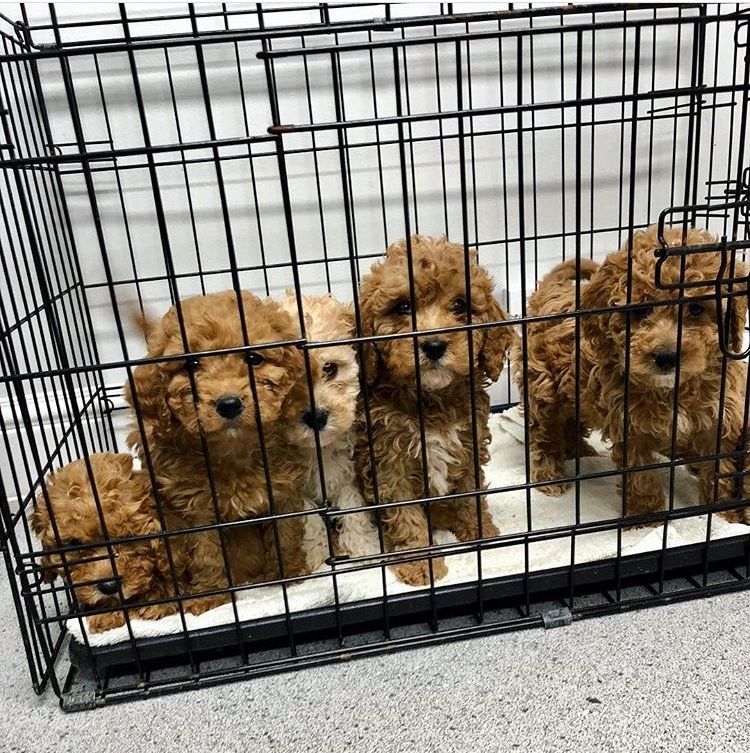
Crate Training Can Support Potty Training
A properly introduced crate can become a useful part of your puppy’s routine.
The crate should be a comfortable, positive space rather than a punishment area.
Your puppy should have enough room to stand, turn around, lie down, and move comfortably. However, excessive space can make it easier for a puppy to eliminate in one area and sleep in another.
Crate time should also be matched with your puppy’s developmental needs.
A young Cavapoo should not be expected to remain in a crate for long periods simply because you are busy.
If your puppy needs a bathroom break, arrange one.
What About Puppy Pads?
Puppy pads can be useful in certain situations.
They may be particularly helpful for families living in apartments or homes where getting outside quickly is difficult. They can also provide an indoor potty option when outdoor access is temporarily limited.
However, you should decide what your long-term goal is.
If you want your Cavapoo to eliminate exclusively outdoors, relying heavily on indoor pads may introduce an additional bathroom location that your puppy must learn to understand.
There is no single approach that works for every household.
Choose the system that fits your living situation and remain consistent with it.
What If Your Cavapoo Keeps Having Accidents?
Don’t panic.
Repeated accidents do not automatically mean your puppy is stubborn or difficult to train.
There could be several explanations.
Your puppy may:
- Be too young
- Need more frequent potty breaks
- Have too much freedom
- Have an inconsistent schedule
- Become distracted outside
- Need additional supervision
- Be experiencing a medical problem
If accidents continue, go back to the basics.
Increase potty breaks.
Reduce unsupervised freedom.
Return to a predictable schedule.
Reward successful bathroom trips.
Then gradually increase freedom again as your puppy improves.
The American Kennel Club notes that potty training can take months for some puppies and that giving puppies too much freedom too early can contribute to accidents.
Don’t Forget Nighttime Potty Breaks
Nighttime can be one of the hardest parts of puppyhood.
Your Cavapoo puppy may not be physically capable of making it through the entire night without a bathroom break.
Before bedtime, take your puppy outside.
Then keep the nighttime trip calm and boring.
Avoid turning it into playtime.
Take your puppy to the designated bathroom area, allow them to eliminate, praise them quietly, and return to bed.
As bladder control develops, nighttime breaks should gradually become less necessary.
When Should You Contact Your Veterinarian?
Potty training takes time, but sudden or unusual changes should not always be treated as a training problem.
If a puppy that was previously doing well suddenly begins having frequent accidents, talk with your veterinarian.
Frequent urination, straining, discomfort, diarrhea, unusual thirst, lethargy, or other symptoms can indicate a health problem that needs professional attention.
The American Kennel Club also recommends veterinary evaluation when a puppy is not progressing with housetraining or develops unusual elimination problems.
Your veterinarian can help determine whether the issue is developmental, behavioral, dietary, or medical.
How Long Does Cavapoo Potty Training Take?
There is no exact deadline.
Some puppies make rapid progress.
Others need considerably more time.
Your Cavapoo’s age, previous routine, personality, consistency, supervision, and physical development can all affect the process.
The important thing is to look for progress rather than perfection.
Maybe your puppy goes from having several accidents each day to one.
Then perhaps they go several days without an accident.
Those improvements matter.
Keep reinforcing the behavior you want.
A Successful Potty Training Routine Starts With Patience
Potty training is one of the first major lessons your Cavapoo puppy will learn after coming home.
It teaches more than where to go.
It teaches your puppy how household routines work. It teaches them to respond to your cues. It builds communication between you and your puppy.
Most importantly, it gives you an opportunity to build trust.
There will probably be accidents.
There may be frustrating mornings.
You might clean the same spot more than once.
That’s puppyhood.
With consistency, supervision, positive reinforcement, and patience, your Cavapoo can gradually develop reliable bathroom habits.
And one day, you’ll realize something wonderful.
Your puppy quietly walks to the door.
You open it.
They go outside.
No accident.
No chaos.
Just a successful little routine that started with one tiny puppy learning how to grow up.
Raising a Healthy, Confident Cavapoo
Potty training is only one part of giving your puppy a strong start.
Nutrition, veterinary care, socialization, exercise, training, grooming, and a predictable home environment all contribute to your Cavapoo’s development.
At Atlantic Cavapoo Puppies Home, our goal is to help families understand what life with a Cavapoo puppy can really look like.
If you’re preparing for your new puppy, explore our Cavapoo puppies for sale and learn more about the puppies currently available.
You can also learn about our Cavapoo breed guide to better understand temperament, grooming, exercise, and everyday care.
For families preparing for the transition home, our puppy adoption process provides another useful resource.
And if you want to understand what happens after your puppy arrives, our puppy health guarantee explains the health support provided as part of the puppy journey.
Final Thoughts
A Cavapoo puppy does not learn bladder control overnight.
They learn through repetition.
They learn through routine.
They learn through your patience.
Give your puppy frequent opportunities to succeed. Watch for their signals. Keep their routine predictable. Reward good decisions and avoid punishment when accidents happen.
Most importantly, remember that every puppy develops at their own pace.
The tiny accidents of puppyhood will eventually become memories.
The habits you teach today can become the foundation for a clean, confident, well-adjusted companion tomorrow.
Helpful External Resources
For additional professional guidance, the American Kennel Club’s puppy potty-training guide provides detailed recommendations for establishing routines, recognizing potty signals, and rewarding successful behavior.
You can also review VCA Animal Hospitals’ house-training guidance for additional information about supervision, potty cues, accidents, and positive training methods.

Pingback: How to Raise a Cavapoo Puppy: 12 Best Tips for New Owners