
Cavapoo Care Guide, Cavapoo Training Guide
How to Bell Train a Cavapoo Puppy for Potty Training: Step-by-Step Guide
Sep
Potty training is one of the first major challenges many new puppy owners face. A young Cavapoo has to learn where to eliminate, when to ask for a bathroom break, and how to follow the routine you establish at home. One training tool that can make communication easier is a simple potty bell.
Bell training a puppy can teach your Cavapoo to use a bell or button as a signal that they need to go outside. Instead of relying entirely on barking, whining, scratching at the door, or hoping you notice subtle signs such as sniffing and circling, your puppy can learn a consistent way to communicate.
The important thing to understand is that a bell does not replace puppy potty training. It is a communication signal that works alongside a predictable schedule, supervision, appropriate bathroom opportunities, and positive reinforcement.
For a Cavapoo puppy, this can be especially useful because you are teaching several skills at once. Your puppy learns where the bathroom area is, how to communicate with you, how to wait for the door to open, and how to repeat behaviors that produce positive results.
Successful Cavapoo potty training also depends on your puppy’s age and development. Young puppies have immature bladder control, so accidents are expected during the learning process. Consistency, supervision, and frequent opportunities to succeed are central to puppy house training.
What Is Bell Training for Puppies?
Bell training teaches your puppy to make a bell or button produce a sound or signal before you take them to their designated potty area.
The basic communication pattern is simple:
Bell → door opens → potty area → bathroom → reward
With enough repetition, your puppy can learn that touching the bell is connected with going outside to relieve themselves.
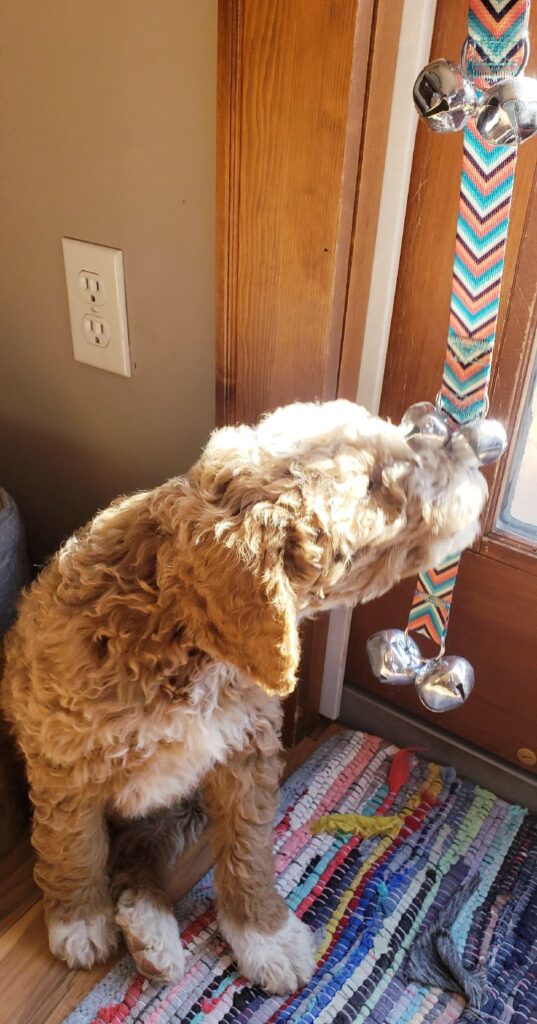
Some owners use hanging bells attached to a door handle, while others prefer a floor-level bell or a communication button that the puppy can press with a paw or nose.
The exact equipment matters less than consistency. Your puppy needs to experience the same sequence repeatedly so the meaning of the signal becomes clear.
AKC guidance similarly describes bell or button training as a communication method that can help dogs tell their owners they need to go outside. The association develops through repetition, demonstration, and positive reinforcement.
This is why puppy bell training works best when it becomes part of your everyday routine instead of being treated as a completely separate trick.
Is Bell Training a Good Method for a Cavapoo Puppy?
Yes, bell training can be a useful addition to a Cavapoo’s potty-training routine.
Cavapoos are intelligent, people-oriented companion dogs, but individual puppies learn at different speeds. Some may understand the bell quickly, while others need many repetitions before they begin using it independently.
The goal should not be to force your puppy to ring a bell. Instead, make the bell part of a predictable routine.
Every time it is time for a potty trip, use the bell before opening the door. Eventually, your Cavapoo can begin making the connection:
“When I need to go outside, I can touch this bell.”
Bell training can be particularly convenient for families living in apartments, condos, townhomes, or homes where the puppy’s designated exit is not always within immediate reach.
However, puppies still need frequent opportunities to eliminate. A bell cannot make a very young puppy physically capable of holding their bladder longer than they safely can.
That distinction is important when potty training a Cavapoo. The bell teaches communication, while your schedule, supervision, and management teach reliable bathroom habits.
When Should You Start Bell Training?
You can begin introducing the bell when your puppy comes home.
You do not need to wait until your Cavapoo is completely potty trained. In fact, introducing the signal while you are already establishing your potty routine can make the two skills develop together.
Young puppies have limited bladder and bowel control, so successful potty training depends heavily on prevention. Take your puppy out frequently, especially after waking, eating, drinking, playing, and sleeping.
As your puppy matures, their ability to hold it between bathroom breaks will improve.
The timeline is different for every puppy. Some learn the bell quickly but still have occasional accidents because they are physically immature. Others may take longer to understand the communication system.
This is a normal part of Cavapoo puppy development. Your puppy may understand a training concept before having the physical maturity and self-control needed to perform it consistently.
The objective is steady progress rather than perfection.
What You Need for Bell Potty Training
Bell potty training does not require expensive equipment.
You can use:
- A hanging dog potty bell
- A small bell attached to a door
- A floor-level bell
- A dog communication button
- Small puppy training treats
- A leash
- A designated outdoor potty area
- An enzymatic cleaner for accidents
- A consistent household routine
Choose a bell that is easy for your puppy to activate but not so loud that it frightens them.
If you have a very small Cavapoo puppy, make sure the bell is positioned at a comfortable height. Your puppy should be able to reach it without jumping or struggling.
If the sound makes your puppy nervous, slow down. Allow them to investigate the bell from a comfortable distance and reward calm interest before asking them to touch it.
The goal of how to teach a puppy to ring a bell is not to create fear around the equipment. You want your puppy to see the bell as a safe and useful communication tool.
Step 1: Introduce Your Cavapoo to the Bell
Start by allowing your puppy to investigate the bell.
Place it somewhere calm and let your Cavapoo sniff it. Reward curiosity and calm interaction.
You can then teach your puppy that touching the bell produces a reward.
For example, hold a treat near the bell so your puppy moves toward it. When their nose or paw touches the bell, immediately praise and reward.
At this stage, you are not necessarily asking your puppy to understand “potty.”
You are simply teaching:
Touch bell = good things happen.
Keep the training sessions short. A few successful repetitions are more useful than a long session that leaves your puppy frustrated.
This early stage is a simple form of positive reinforcement puppy training. You are rewarding a behavior you want your puppy to repeat rather than using fear or punishment.
Step 2: Put the Bell Near the Potty Door
Once your Cavapoo is comfortable with the bell, move it to the door you normally use for bathroom trips.
Now begin connecting the bell with going outside.
Every time you are about to take your puppy out for a scheduled potty break, bring them to the bell.
Encourage them to touch or ring it.
As soon as the bell rings, calmly open the door and take your puppy to the designated potty area.
This repetition is what gives the bell its meaning.
Your puppy starts learning:
Touch bell → door opens → outside.
AKC recommends consistently ringing or pressing the signal before taking the dog outside so the association becomes clear through repetition.
Step 3: Add a Consistent Verbal Cue
Choose one short phrase and use it consistently.
Examples include:
“Outside.”
“Potty.”
“Go potty.”
“Bathroom.”
The specific phrase is less important than using the same cue consistently.
You can say the cue as your puppy touches the bell or immediately before the door opens.
Over time, your puppy can learn that the verbal cue, bell, door, and potty routine are connected.
This also supports broader Cavapoo puppy training because your puppy is learning to associate words, actions, and consequences.
Step 4: Go Directly to the Potty Area
When the bell rings during training, take your puppy directly to the place where you want them to eliminate.
Keep the beginning of the trip boring and predictable.
This is especially helpful when your puppy becomes distracted by grass, leaves, birds, smells, people, or other animals.
A leash can help you stay focused on the purpose of the trip.
Give your Cavapoo time to sniff and find the right spot, but avoid turning every potty trip into a long play session before they eliminate.
The purpose of this part of puppy bathroom training is to make the sequence easy for your puppy to understand.
Step 5: Reward the Actual Potty Behavior
This is one of the most important parts of the entire process.
Your puppy should not receive a high-value reward simply because the bell made a sound.
The most important behavior you want to reinforce is eliminating in the correct location.
When your Cavapoo successfully pees or poops in the designated area, praise them and give an appropriate reward immediately afterward.
This teaches:
Bell → outside → potty → reward.
That complete sequence is much clearer than teaching your puppy that ringing the bell automatically produces treats.
Positive reinforcement is a core part of effective puppy potty training, and immediate rewards help the puppy connect the reward with the behavior you want.
Step 6: Let Your Puppy Begin Ringing the Bell Independently
After enough repetition, your Cavapoo may begin touching the bell without your assistance.
The first time this happens, pay attention.
If the timing suggests your puppy genuinely needs to go, respond promptly and take them outside.
You want your puppy to learn that the bell is an effective way to communicate.
Eventually, you may notice your Cavapoo walking toward the door, looking at you, touching the bell, or combining several signals.
These behaviors can become part of your puppy’s communication system.
This is one of the most rewarding parts of bell potty training because your puppy begins taking an active role in the process.
What If Your Puppy Rings the Bell Constantly?
This is one of the most common challenges with bell potty training.
Your Cavapoo may discover that ringing the bell makes the door open.
Then your puppy may decide:
“Bell means outside!”
That can quickly become:
“I want to play outside, so I’ll ring the bell.”
This does not necessarily mean your puppy is being manipulative. They have simply discovered that a particular behavior produces an interesting result.
The solution is not to punish the puppy for ringing the bell.
Instead, keep the potty routine predictable.
When the bell rings, take your puppy out for a calm bathroom opportunity. Go to the designated potty area and give them a reasonable chance to eliminate.
If they potty, reward them.
If they do not potty, calmly return indoors.
This helps preserve the meaning of the bell without turning every ring into an extended outdoor play session.
Don’t Make the Bell Mean “Fun Is Over”
There is another subtle issue to consider.
If every successful potty trip immediately ends the opportunity to explore, sniff, or enjoy the outdoors, some puppies may eventually learn that eliminating means their outdoor time ends.
That can make them reluctant to potty quickly.
A better approach is to distinguish between the potty behavior and the reward that follows it.
After your puppy eliminates, you can sometimes allow a few minutes of calm sniffing, walking, or age-appropriate play.
This helps your Cavapoo understand that going potty does not necessarily mean immediate confinement indoors.
Teaching a potty cue in this way can also help prevent outdoor bathroom behavior from becoming a rushed or stressful experience.
Bell Training Should Work With a Potty Schedule
A common mistake is expecting the bell to do all the work.
A very young puppy may not understand that they should ring the bell until the last possible second.
They may also become distracted and forget.
That is why a puppy potty training schedule remains important.
Take your Cavapoo outside regularly and anticipate predictable bathroom times, including after:
- Waking up
- Eating
- Drinking
- Naps
- Active play
- Exercise
- Exciting activity
Young puppies generally need frequent opportunities because bladder control is still developing. AKC recommends regular potty breaks, including after meals, drinking, naps, crate time, and play.
Your exact schedule should be adjusted to your puppy’s age, individual needs, routine, and veterinary guidance.
As your puppy becomes more reliable, you can gradually adjust the routine.
The bell then becomes an additional communication tool rather than your only method of knowing when your puppy needs to go.
Watch for Natural Potty Signals Too
Even when you are teaching bell training, continue learning your puppy’s natural body language.
Your Cavapoo may:
- Sniff the floor repeatedly
- Circle
- Wander away from the family
- Suddenly become restless
- Walk toward the usual exit
- Whine
- Pace
- Stop playing and start searching
- Look at you and then toward the door
These signals can be especially valuable during the early stages of training.
If you notice one, respond immediately rather than waiting for the bell.
Over time, your puppy may replace some of these natural signals with the bell.
What to Do When Your Puppy Has an Accident
Accidents are a normal part of puppy potty training.
Do not punish, yell at, or frighten your Cavapoo for an accident.
If you catch your puppy beginning to eliminate indoors, calmly interrupt and take them to the appropriate potty area.
If they finish in the correct place, reward them.
If you discover an accident after it has already happened, simply clean it thoroughly.
Do not lecture your puppy afterward. They are unlikely to understand why you are upset about something that happened earlier.
Thorough cleaning is also important because lingering odors can encourage a puppy to return to the same location.
An enzymatic pet stain cleaner can help remove odor rather than simply covering it.
Positive reinforcement, supervision, and prevention are generally more useful than punishment when teaching house-training behavior.
Remember that puppy potty training accidents do not automatically mean your training plan has failed. Accidents can happen because of age, timing, distractions, changes in routine, or insufficient supervision.
Should You Use a Crate With Bell Training?
A properly introduced crate can complement potty training, but it should never be used as punishment.
A crate gives your puppy a safe, controlled space when you cannot supervise them directly. It can also help you manage access to the home while your puppy is still learning.
However, a crate does not eliminate the need for frequent potty breaks.
Young puppies cannot simply be expected to remain confined for long periods without bathroom opportunities.
Your Cavapoo should have an age-appropriate potty schedule, adequate exercise, mental stimulation, rest, and human interaction.
Bell training and crate training can therefore work together:
Crate/rest → potty trip → bell → outside → potty → reward → supervised freedom.
A properly sized and positively introduced crate can support house training by reducing opportunities for accidents while helping your puppy develop appropriate routines.
How Bell Training Works for Apartment Cavapoos
Bell training can be particularly useful in apartments and condos.
Instead of waiting for your puppy to bark or scratch at the door, you can teach them to use a specific signal.
The challenge for apartment owners is that reaching the outdoor potty area may take longer. You may have to cross a hallway, use an elevator, walk through a lobby, or travel outside the building.
Because young puppies have limited bladder control, planning is essential.
Keep the leash, shoes, treats, and other essentials ready near the exit.
If getting outside quickly is not practical, talk with your veterinarian or trainer about whether an indoor potty solution is appropriate for your circumstances.
Indoor potty training can be useful in some situations, but it should be introduced deliberately so the puppy understands where the approved toilet area is.
How Long Does Bell Potty Training Take?
There is no universal timeline.
Some puppies begin touching the bell within several days. Others need weeks of consistent practice.
More importantly, learning to ring the bell is not the same thing as becoming completely house-trained.
Your Cavapoo might understand the bell but still have accidents because they are young.
Another puppy might become reliable with bathroom habits but rarely use the bell because they prefer going to the door.
Both can represent progress.
Focus on the larger objective: your puppy learns where to eliminate and develops a reliable way to communicate when they need a bathroom opportunity.
Your puppy’s age, previous experience, consistency, supervision, and Cavapoo puppy development can all affect how quickly the process becomes reliable.
Common Bell Training Mistakes
Changing the Routine Constantly
If the bell is sometimes used before potty trips and sometimes ignored, your puppy may struggle to understand what it means.
Consistency matters.
Waiting for the Bell Before Taking Your Puppy Outside
Do not wait for a very young puppy to ring the bell before giving them a bathroom opportunity.
Scheduled breaks remain necessary.
Rewarding the Bell Instead of Pottying
The bell is a communication behavior. The main bathroom reward should be connected to successful elimination in the correct location.
Turning Every Bell Ring Into Playtime
If ringing the bell immediately produces a long outdoor adventure, your puppy may start using the bell simply to access entertainment.
Keep bathroom trips purposeful during training.
Punishing Accidents
Punishment can create fear and may cause a puppy to hide when they need to eliminate.
Calm interruption, prevention, cleaning, supervision, and rewarding correct behavior are more productive.
Giving Too Much Freedom Too Soon
A puppy who has been accident-free for several days is not necessarily ready to roam the entire house.
Increase freedom gradually as reliability improves.
These principles are consistent with current AKC guidance on puppy house training, which emphasizes routine, supervision, positive reinforcement, and gradual freedom.
How to Make Bell Training Easier for Your Cavapoo
The simplest way to improve results is to make the desired behavior easy to repeat.
Keep the bell in the same location.
Use the same exit door.
Use the same potty area during the early stages.
Keep rewards nearby.
Use the same verbal cue.
Maintain a predictable schedule.
Supervise your puppy closely.
Reward successful bathroom trips immediately.
Clean accidents thoroughly.
And make sure everyone in the household follows the same routine.
If one family member ignores the bell while another immediately responds, your puppy receives mixed information.
Consistency from humans is just as important as consistency from the puppy.
This approach also makes puppy house training easier because your Cavapoo experiences fewer confusing changes.
When to Give Your Cavapoo More Freedom
Potty training is not finished simply because your puppy has learned to ring a bell.
Your puppy also needs to demonstrate reliable bathroom habits.
Begin with controlled access to a small portion of the home. As your Cavapoo demonstrates consistent success, gradually allow access to additional areas.
If accidents return, reduce freedom temporarily and return to closer supervision.
This is not a failure. It is simply information that your puppy needs more practice before progressing.
AKC guidance similarly recommends gradually expanding a puppy’s freedom rather than giving unrestricted access too early.
What If My Cavapoo Stops Using the Bell?
Do not assume your puppy has forgotten everything.
Consider what changed.
Did the bell move?
Did the family change the exit door?
Did the potty area change?
Has the puppy’s daily schedule changed?
Has the puppy started spending more time alone?
Is the bell making an unpleasant sound?
Has your puppy had a stressful experience?
Return to the basics.
Start ringing the bell yourself before potty trips and reward your puppy for interacting with it. Rebuild the association gradually.
Remember that puppies can go through different stages of learning as their behavior and development change.
When Potty Problems May Need Veterinary Attention
Training problems are not always behavioral.
If a previously reliable puppy suddenly begins having frequent accidents, urinates unusually often, strains to urinate, seems uncomfortable, drinks excessively, has diarrhea, or shows other concerning symptoms, contact your veterinarian.
Urinary and gastrointestinal problems can affect bathroom habits.
Persistent house-soiling despite a consistent training program may also justify veterinary evaluation.
The goal is to avoid assuming that every potty problem is simply a training issue. AKC also recommends veterinary evaluation when persistent house-soiling does not improve with appropriate training and management.
A Simple Cavapoo Bell Training Routine
For many families, the process can be simplified into one repeatable routine.
When your puppy needs a scheduled bathroom break, walk to the bell.
Help your Cavapoo touch the bell.
Say your chosen cue.
Open the door.
Attach the leash if needed.
Walk directly to the designated potty area.
Wait calmly.
When your puppy eliminates, immediately praise and reward.
Allow a little appropriate outdoor enrichment when practical.
Return home.
Repeat the same process throughout the day.
After enough repetitions, your puppy may begin taking over more of the process.
This simple sequence is essentially how to bell train a puppy while keeping the larger potty-training goal in focus.
Bell Training Checklist for Cavapoo Puppies
Before starting, make sure you have:
- A puppy-safe bell or communication button
- One consistent exit door
- A designated potty area
- A leash ready near the door
- Small training rewards
- A predictable puppy potty training schedule
- An enzymatic cleaner
- A consistent verbal cue
- A household agreement about the training routine
- Patience for accidents and slower learning days
The more predictable the environment is, the easier it becomes for your puppy to recognize patterns.
Cavapoo Puppies For Sale Near Me: Start Potty Training From Day One
Families searching for Cavapoo Puppies For Sale Near Me often focus on finding a healthy puppy, but preparing for the first few weeks at home is equally important.
Before bringing a Cavapoo puppy home, prepare the crate, leash, potty area, food, treats, cleaning supplies, and training plan.
Cavapoo potty training should begin from the beginning rather than waiting until accidents become a habit.
Bell training can then become one part of your puppy’s larger house-training system.
If you are currently looking for an available Cavapoo puppy, you can explore Atlantic’s available puppies and learn more about the process before bringing your puppy home.
Cavapoo Puppies For Sale In Tennessee: Prepare for Potty Training
If you are researching Cavapoo Puppies For Sale In Tennessee, think ahead about the environment your puppy will experience after coming home.
Tennessee weather can vary throughout the year, so your potty routine may sometimes need adjustments for rain, heat, cold, or severe weather.
Your puppy should still have a consistent designated bathroom area, but you can make the route to that area as easy and predictable as possible.
A bell near the exit can help your Cavapoo communicate that they need a bathroom opportunity.
Cavapoo Puppies For Sale In Ohio: Build a Reliable Routine
Families searching for Cavapoo Puppies For Sale In Ohio should also consider how seasonal weather can affect puppy potty training.
Rain, snow, ice, and cold temperatures can make outdoor trips less convenient, particularly with a young puppy.
That makes preparation even more useful.
Keep your leash and rewards ready, choose a practical potty location, and make sure your puppy can reach the exit safely.
If outdoor conditions temporarily make normal potty trips difficult, discuss appropriate alternatives with your veterinarian.
Cavapoo Puppies For Sale In Florida: Potty Training in Warm Weather
For families searching for Cavapoo Puppies For Sale In Florida, heat and heavy rain can influence your puppy’s outdoor routine.
Choose a practical potty area that is safe and comfortable, and avoid forcing a young puppy to remain outside in uncomfortable weather.
Your Cavapoo still needs regular bathroom opportunities even when outdoor conditions are less convenient.
The bell can help you communicate with your puppy, but the puppy’s physical needs always come first.
Frequently Asked Questions About Bell Training a Puppy
Can any Cavapoo puppy learn to ring a bell?
Many puppies can learn the behavior with consistent positive reinforcement, although individual learning speed varies.
How old should a puppy be before bell training?
You can introduce the bell when your puppy comes home. Keep sessions short and simple.
Does bell training replace puppy potty training?
No. The bell is a communication signal. Your puppy still needs supervision, scheduled potty breaks, and reinforcement for eliminating in the correct place.
What is the easiest way to bell train a puppy?
Start by introducing the bell, then place it near the potty door. Ring it or help your puppy touch it before every scheduled trip outside. Over time, your puppy can learn that the bell signals a bathroom opportunity.
How do I teach a puppy to ring a bell?
Allow your puppy to investigate the bell first. Reward calm interest, then reward nose or paw touches. Once your puppy understands the action, connect the bell with going outside.
Should I put the bell on the door?
You can. Hanging bells are popular because they are easy to associate with the exit, but a floor-level bell or communication button can also work.
Should I use treats every time my puppy rings the bell?
The most important reward should be connected to successful potty behavior. Otherwise, your puppy may learn that ringing the bell itself produces treats.
What if my puppy rings the bell just to go outside?
Take the puppy out for a calm potty opportunity. If they do not need to eliminate, return indoors rather than turning every bell ring into extended playtime.
What if my puppy is afraid of the bell?
Do not force interaction. Introduce the bell gradually and reward calm investigation. If necessary, try a quieter bell or button.
Should I ring the bell for my puppy?
Yes. During the teaching phase, ringing the bell yourself immediately before going outside helps create the association. AKC specifically recommends consistently using the bell or button before outdoor potty trips.
How many times should I practice puppy bell training each day?
You can practice naturally throughout the day because potty trips provide repeated opportunities. Short, successful repetitions are preferable to long formal sessions.
Can bell training work in an apartment?
Yes. A bell can provide a clear signal for an apartment puppy, although young puppies may still need very frequent bathroom trips.
Should my puppy wear a leash during potty training?
A leash can help you guide your puppy directly to the designated potty area and supervise what happens outside.
What if my puppy has an accident after learning the bell?
Go back to closer supervision and more frequent potty opportunities. Accidents can happen even when a puppy appears to understand the routine.
Should I punish my puppy for potty training accidents?
No. Calmly clean the accident and focus on preventing future mistakes while rewarding correct behavior. Punishment can create fear and confusion rather than teaching the desired behavior.
Can crate training and bell training be used together?
Yes. A crate can help with management and rest while bell training provides a communication signal for bathroom trips.
How long does it take to completely potty train a Cavapoo?
There is no fixed timeline. Development, routine, supervision, previous experience, and individual temperament all influence the process.
Why does my puppy ring the bell but not potty?
Your puppy may have learned that the bell opens the door without yet understanding that it specifically communicates a bathroom need. Keep the response calm and purposeful.
Should I stop using the bell once my puppy is potty trained?
Not necessarily. Many dogs continue using a bell or button as a useful communication system even after they become reliably house-trained.
Final Thoughts: Make the Bell Part of a Bigger Potty Training Plan
Bell training can be a simple and effective way to help your Cavapoo communicate with you.
The key is not the bell itself. The real training happens through repetition.
Your puppy learns that touching the bell is followed by going outside, visiting the appropriate potty area, eliminating, and receiving positive reinforcement.
Keep your expectations realistic. Young puppies need frequent bathroom opportunities and may have accidents even when training is progressing well.
Use supervision, consistency, patience, positive reinforcement, and gradual freedom. Watch your puppy’s natural signals, maintain a predictable routine, and respond promptly when your puppy communicates.
Remember that potty training a Cavapoo involves more than teaching a single behavior. Your puppy is developing bladder control, communication skills, household habits, and self-control at the same time.
With time, your Cavapoo may confidently walk to the door, ring the bell, and give you a clear signal that it is time for a bathroom break.
That simple sound can become one of the most useful communication habits your puppy learns.
Continue Learning About Cavapoos
If you’re preparing for a Cavapoo puppy or already have one at home, continue building your knowledge with these helpful Atlantic resources:
Available Cavapoo Puppies — Explore available puppies and learn more about bringing a Cavapoo home.
Cavapoo Breed Guide — Learn about Cavapoo temperament, size, grooming, personality, and care.
Cavapoo Care Guide — Get practical information for caring for your Cavapoo throughout puppyhood and beyond.
Cavapoo Buying Guide — Learn what to consider before choosing a Cavapoo puppy.
Cavapoo Puppies by State — Explore location-specific Cavapoo information for families across the United States.
Puppy Buying Checklist — Use a practical checklist when preparing to bring your puppy home.
Questions to Ask Before Buying a Cavapoo Puppy — Know what to ask before making a puppy purchase.
Health Guarantee — Learn more about Atlantic’s health-related commitments.
Shipping & Delivery — Review available puppy delivery information.
Adoption Process — Understand the steps involved in bringing an Atlantic Cavapoo puppy home.
Frequently Asked Questions — Find answers to common Cavapoo puppy questions.
